Table of Contents
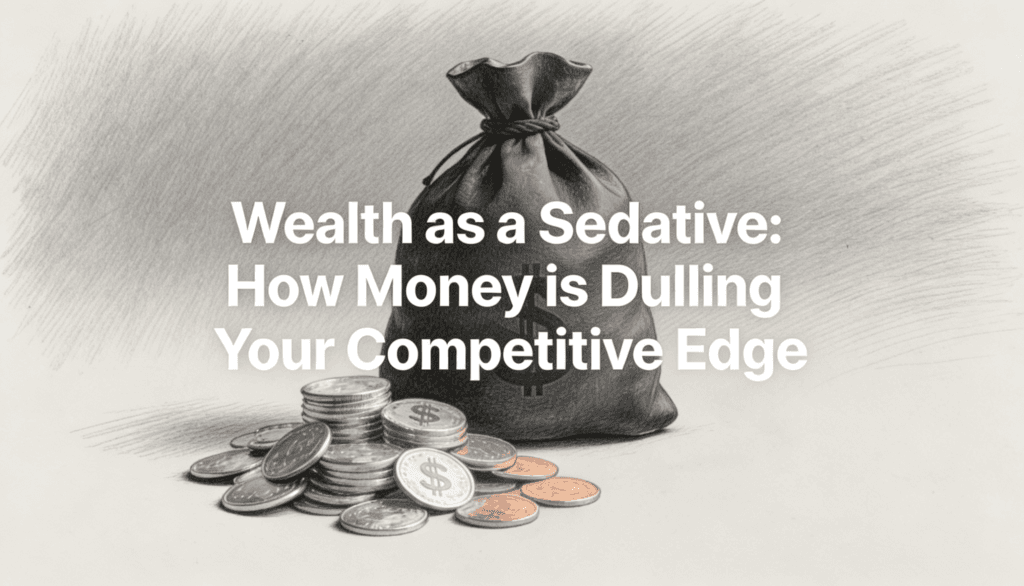
There is a paradox sitting at the center of every successful investor’s life, and almost nobody talks about it. The very wealth you spent years building is quietly working against you. Not in some dramatic, blow-up-your-portfolio way. More like a slow anesthetic dripping into your decision making, numbing the instincts that made you sharp in the first place.
You worked harder when you had less. You know this. The question is whether you have the honesty to admit what that means now.
The Comfort Threshold
Every person has a number. Not a retirement number or a net worth goal, but a psychological threshold where money stops feeling like a tool and starts feeling like a cushion. Cross that line, and something shifts in how you process risk, evaluate opportunity, and respond to loss.
Behavioral economists have studied this for decades under different labels. Prospect theory. Loss aversion. The endowment effect. But the real phenomenon is simpler than any academic framework suggests. When you have enough, your brain quietly reclassifies ambition from necessity to optional.
Think about the last time you passed on an investment that felt uncomfortable. Not reckless. Uncomfortable. The kind of opportunity that five or ten years ago would have kept you up at night running numbers, calling people, doing the work. Now you scroll past it. You tell yourself you are being disciplined. You might just be comfortable.
Discipline and comfort wear the same outfit. The difference is that discipline is a choice made despite desire, while comfort is the absence of desire altogether. If you can not tell which one is driving your decisions, that is the first symptom.
The Biology of Enough
This is not just psychology. It is physiology.
Dopamine, the neurotransmitter most associated with motivation and reward seeking, does not respond to what you have. It responds to the gap between what you have and what you expect. When you were building wealth from a lower base, every gain was a surprise. Every successful trade or investment lit up the reward circuitry because the distance between expectation and outcome was wide.
Now that distance has collapsed. Your baseline has shifted. A ten percent return on a large portfolio might represent more absolute dollars than your entire net worth was fifteen years ago, but your brain processes it as routine. Expected. Boring.
This is the biological version of inflation. Your nervous system adjusts to wealth the same way economies adjust to money supply. More of it does not create more motivation. It creates less sensitivity.
Athletes understand this intuitively. There is a reason so many championship teams fail to repeat. It is not that they suddenly forgot how to play. It is that the hunger that made them extraordinary got replaced by the satisfaction of having already won. The fire does not go out. It just gets turned down to a simmer that feels warm enough to mistake for intensity.
The Diversification Trap
Here is where it gets interesting. One of the most celebrated principles in investing, diversification, can actually accelerate this sedation.
When you diversify broadly enough, you insulate yourself from the emotional extremes that keep you engaged. You will never feel the gut punch of a concentrated position collapsing, but you will also never feel the electric thrill of a conviction bet paying off. You have engineered volatility out of your portfolio, and along with it, you have engineered out a significant portion of your emotional investment in the outcome.
This is not an argument against diversification. It works. But it is worth recognizing that the emotional cost of reducing risk is reduced engagement. And reduced engagement, over long periods, leads to a kind of autopilot investing where you are technically still in the game but mentally checked out.
The investors who stay sharp despite wealth tend to keep at least some portion of their capital in positions that demand their attention. Not gambling. Attention. There is a difference between reckless concentration and intentional engagement.
The Social Anesthetic
Money also sedates through social channels. Wealth tends to surround you with people who agree with you. Not because they are dishonest, but because the social dynamics of affluence naturally filter out friction.
When you were earlier in your career, you argued with people. You debated ideas with peers who had nothing to lose by telling you that you were wrong. Your thesis got stress tested in conversations with people who did not care about your feelings or your portfolio size.
Now your ideas get validated. Financial advisors have an economic incentive to agree with you. Friends in similar positions share similar blind spots. The information ecosystem around a wealthy person tends to become a mirror rather than a window.
This matters enormously for investment performance because good investing requires regular contact with people who see the world differently than you do. The best hedge against cognitive decay is not another asset class. It is someone who will look at your favorite position and tell you exactly why it might be wrong.
The Delegation Problem
As wealth grows, so does the temptation to delegate decisions. Hire the advisor. Let the fund manager handle it. Set it and forget it.
Delegation is rational up to a point. Nobody can manage everything personally as complexity scales. But there is a version of delegation that is not about efficiency. It is about avoidance. You are not delegating because someone else is better suited for the task. You are delegating because engagement has become effortful and your wealth has made effort optional.
The tell is easy to spot. If you can not explain, in specific terms, what your money is doing and why, you have not delegated. You have abdicated. Delegation means you chose someone and are overseeing the outcome. Abdication means you handed over the keys because you did not feel like driving.
The irony is sharp. You spent years developing financial acumen and judgment. Those are arguably your most valuable assets. And now you are paying someone else to use versions of those same skills because you have become too comfortable to use your own.
The Generational Echo
This pattern does not stop with the individual. It echoes forward.
There is a well known observation that wealth rarely survives three generations. The first generation builds it through hunger and skill. The second generation maintains it through proximity to those values. The third generation, fully sedated by a cushion they never built, treats wealth as a natural state rather than an engineered one.
But the sedation starts earlier than most people think. It often begins in the first generation itself. The builder who stops building. The investor who stops truly investing and starts merely preserving. Preservation sounds responsible. Sometimes it is just another word for giving up the thing that made you exceptional.
This is not a call to take reckless risks or refuse to protect what you have built. It is a recognition that the psychology of preservation is fundamentally different from the psychology of creation, and the transition between them often happens without any conscious decision. One day you are an investor. The next day you are a custodian. And you never noticed the change.
Staying Awake
So what do you do with this information?
The first step is diagnosis. Honestly evaluate whether your reduced risk taking is strategic or symptomatic. Are you avoiding certain investments because your analysis says they are poor opportunities? Or are you avoiding them because the emotional effort of engagement no longer feels worth it? These are very different things, and the difference matters.
The second step is intentional discomfort. This sounds like wellness guru nonsense, but it has a practical application. Keep some portion of your investing life in territory that demands your active attention and real skill. Not your whole portfolio. Enough to keep the feedback loops alive. Enough to feel something when you are wrong.
The third step is adversarial input. Actively seek people who disagree with your market thesis. Not contrarians for the sake of it, but thoughtful people who see risks you are not seeing. Pay them if you have to. The cost of a good critic is trivially small compared to the cost of unchallenged assumptions compounding over years.
The fourth step is the hardest. Periodically remind yourself that your wealth is not evidence of your current skill. It is evidence of your past skill. The market does not award tenure. What made you money ten years ago might be exactly the thinking that costs you money now, and the sedative effect of wealth is what keeps you from noticing the difference.
The Final Irony
Money is supposed to buy freedom. And it does. But the specific freedom it buys most efficiently is the freedom from discomfort. And discomfort, it turns out, was the engine driving your best work.
Your money is not your enemy. But it is not entirely your friend either. It is more like a well meaning relative who keeps refilling your glass and telling you to relax. At some point, you have to decide whether you want to keep drinking or whether you would rather stay sharp enough to notice what is actually happening around you.
The market does not care how comfortable you are. It never has. That used to be obvious.