Table of Contents
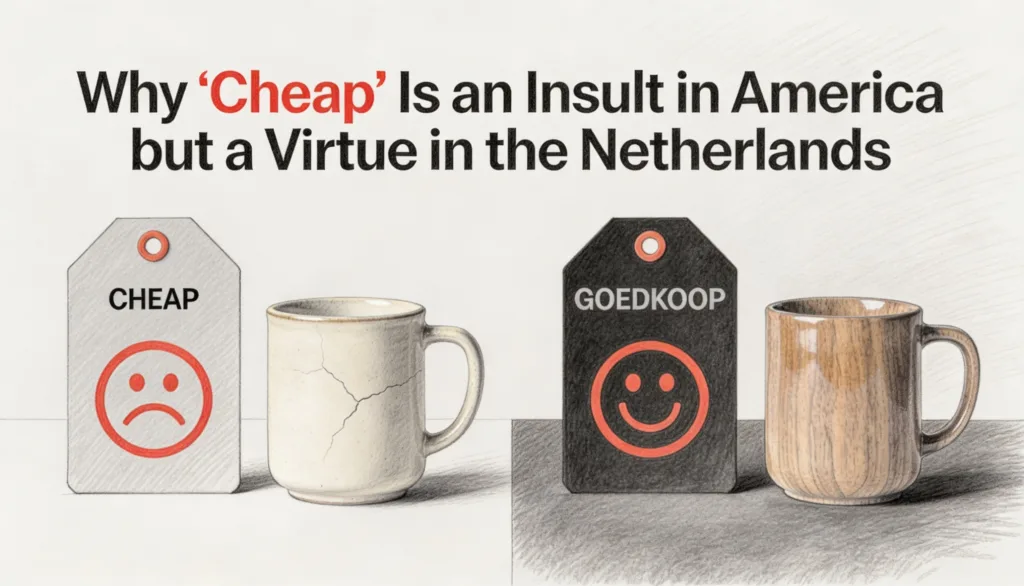
There is something strange about a country that invented the credit card and then made it a moral failing to not use one. In America, calling someone cheap is roughly equivalent to calling them boring, ungenerous, or worst of all, poor. It is a word that carries weight. Not the weight of financial wisdom, but the weight of social shame.
Now fly six thousand miles east to the Netherlands, where splitting a dinner bill down to the cent is not awkward. It is expected. Where riding a bicycle instead of driving a car is not a sign that something went wrong in your career. It is a sign that nothing went wrong in your thinking.
Same behavior. Opposite meaning. That gap tells us more about wealth, culture, and investing psychology than most finance textbooks ever will.
The Spending Identity
Americans do not just spend money. They perform spending. The car in the driveway, the kitchen renovation, the vacation posted on Instagram. These are not simply purchases. They are announcements. They say something about who you are, where you stand, and whether you belong.
This is not vanity in the shallow sense. It runs deeper than that. America was built on the idea that anyone can become anything. That is beautiful in theory. But in practice, it creates a problem. If anyone can rise, then you need to constantly prove that you have risen. And the quickest proof available is what you spend.
The Dutch have a phrase for this kind of showing off. They call it “doe maar normaal.” It roughly translates to “just act normal.” It is the cultural equivalent of someone pulling you aside at a party and whispering, “You are doing too much.” In the Netherlands, flaunting wealth does not earn admiration. It earns suspicion. People wonder what you are compensating for.
This creates two entirely different financial ecosystems. In one, spending is the scoreboard. In the other, spending is noise.
A Brief History of Two Wallets
The roots of this divide are not mysterious if you look at where each culture came from.
The Dutch Golden Age of the 1600s produced some of the wealthiest merchants in the world. But it also produced Calvinism, which essentially taught that God keeps receipts. Frugality was not just smart. It was holy. You worked hard, you saved, and you did not make a scene about it. The cultural residue of this era never fully washed away. Even today, Dutch financial norms carry the quiet discipline of people who once ran a global trading empire from a country that is, technically, below sea level. When your land can flood at any moment, you tend to keep reserves.
America had a different origin story. It was a place people went to become something new. The frontier mentality rewarded boldness, risk, and visible success. You did not cross an ocean to blend in. You crossed it to stand out. And standing out costs money, or at least, it costs the appearance of money. This is how a nation ended up where the average household carries thousands in credit card debt and considers it normal. Not because Americans are bad with math. But because the math was never really the point.
The Psychology of the Price Tag
Here is where things get interesting for anyone who thinks about money beyond budgets and interest rates.
Behavioral economists have long known that people do not make financial decisions rationally. But the Dutch and American versions of irrationality point in opposite directions. Americans tend toward what researchers call “conspicuous consumption,” a term coined over a century ago by Thorstein Veblen. The idea is simple. You buy things not for their utility but for their visibility. A watch that costs ten thousand dollars does not tell time ten thousand times better than one that costs ten dollars. But it tells everyone around you something about your bank account. Or at least, what you want them to believe about your bank account.
The Dutch version of irrationality is almost the reverse. There is social pressure to underspend. To drive the older car. To bring your own lunch. To negotiate harder than the situation probably requires. This can tip into its own absurdity.
Both of these are irrational. One group overspends to feel worthy. The other underspends to feel virtuous. The money itself does not care either way.
What This Means for How People Build Wealth
The cultural attitude toward cheapness does not just affect dinner bills. It reshapes how entire populations approach investing, saving, and long term wealth.
The Netherlands consistently ranks among the highest saving countries in Europe. The Dutch pension system is one of the strongest in the world. This is not an accident. When your culture celebrates restraint, the financial infrastructure follows. Saving is not a sacrifice. It is a default setting.
In America, saving requires swimming against the current. Every advertisement, every social norm, every sitcom punchline reinforces the idea that life is happening at the point of sale. The person who drives a modest car and invests the difference is not celebrated. They are invisible. And in a culture that equates visibility with value, invisibility is its own kind of poverty.
This is perhaps the cruelest irony of the American relationship with money. The behaviors most likely to build real wealth are the same behaviors most likely to get you called cheap. Meanwhile, the behaviors that signal wealth, the leased luxury car, the financed renovation, the subscription to everything, are often the very things that prevent it.
The Dutch seem to have figured out something that many American financial advisors spend entire careers trying to teach. Looking rich and being rich are not just different things. They are often opposite things.
The Generosity Paradox
Americans are among the most generous people on earth when measured by charitable giving. The Dutch, despite their fiscal discipline, give less per capita. So does cheapness actually make you less generous?
Not exactly. What it does is redefine what generosity means.
In America, generosity is often public. It is the big donation, the round of drinks, the insistence on picking up the check. These are real acts of generosity. But they are also performances, tied to the same visibility economy that drives spending. The person who picks up the check gets something in return. They get to be seen as the generous one.
In the Netherlands, generosity tends to be structural rather than theatrical. The Dutch pay high taxes that fund universal healthcare, education, and social safety nets. The generosity is baked into the system. It is not optional, it is not dramatic, and nobody gets to post about it. But the outcome, a society where fewer people fall through the cracks, is arguably more generous in effect, even if it is less generous in feeling.
This distinction matters for how we think about money on a personal level. Are you generous because you tip well at restaurants? Or are you generous because you vote for systems that make tipping unnecessary? Both answers are defensible. But only one culture treats the question as settled.
What Investors Can Learn from Both Sides
Strip away the cultural packaging, and there is a useful lesson buried in this divide.
The American approach to money is optimistic. It assumes growth, expansion, and the possibility of more. This mindset fuels entrepreneurship, risk taking, and the kind of bold investment strategies that can produce enormous returns. Silicon Valley does not exist without the cultural willingness to spend big, fail publicly, and try again. The Dutch approach would never have built that.
But the Dutch approach protects against the downside. It builds buffers. It avoids the trap of lifestyle inflation, where every raise gets immediately absorbed by a slightly better version of the life you already had. It treats financial security not as a milestone to reach but as a habit to maintain.
The best investors tend to hold both ideas in tension. They take calculated risks, but they do not confuse spending with investing. They understand that the appearance of wealth and the reality of wealth operate on different tracks. Warren Buffett, who still lives in the house he bought in 1958, might be the most Dutch man in America. He just does not know it.
The Language Tells You Everything
In the end, this comes down to a single word and what a culture decides it means.
Call someone cheap in New York and watch their face change. You have questioned their character. You have implied that they are small, tight, unwilling. The word lands like an accusation.
Call someone cheap in Amsterdam, or more accurately, call them “zuinig,” and you have paid them a compliment. You have said they are careful, thoughtful, disciplined. The word lands like respect.
Neither culture is entirely right. The American fear of cheapness leads to overspending, debt, and the quiet anxiety of maintaining a lifestyle that was never sustainable. The Dutch worship of cheapness can lead to stinginess, missed experiences, and the strange loneliness of a life optimized entirely for efficiency.
But if you had to pick one cultural default to build a financial life on, the Dutch have the better starting position. It is easier to learn to spend wisely when your baseline is saving. It is much harder to learn to save when your baseline is spending.
The Americans built a culture where you have to earn the right to be frugal. You must first prove you could spend, and then choose not to. The Dutch skipped that step entirely. They just started with the not spending part and never felt the need to apologize for it.
There is something deeply efficient about that. You might even call it cheap.