Table of Contents
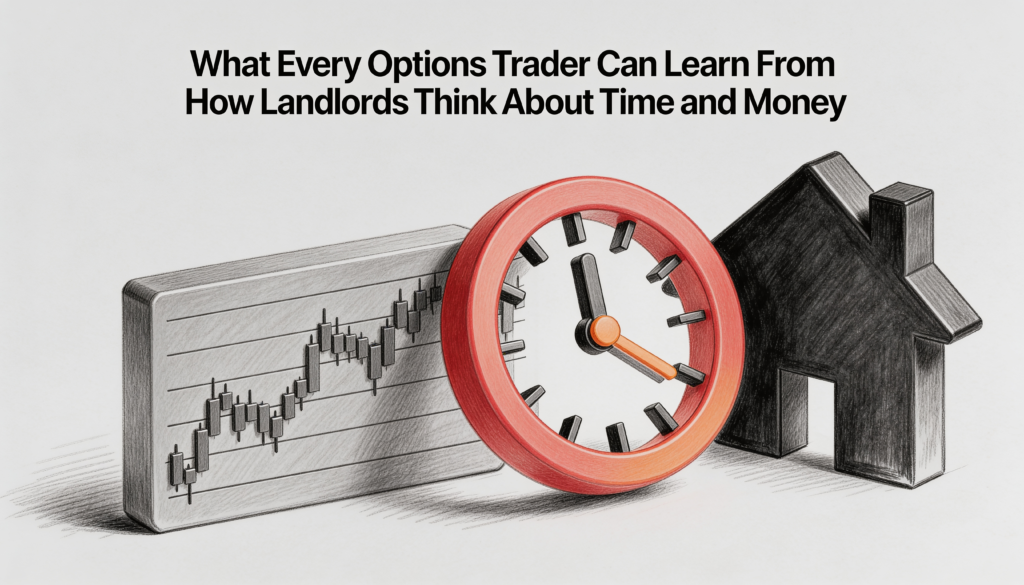
What Every Trader Can Learn From How Landlords Think About Time and Money
There is a particular kind of person who buys a duplex in a boring suburb, spends a weekend fixing a leaky toilet, and then does almost nothing for the next five years except collect rent checks and watch the mortgage balance shrink. And there is another kind of person who, on a Tuesday afternoon, buys call options that expire in three days on a company whose ticker they learned about that morning, and then spends the next seventy two hours refreshing a brokerage app like it owes them money.
Both of these people are trying to get rich. They would describe what they are doing using almost none of the same words. The landlord talks in decades. The trader talks in hours. And the gap between those two time horizons is not really a gap about finance at all. It is a gap about what a person believes time is for. The interesting thing is that the way a landlord thinks about time and money contains a set of transferable lessons that any options trader can borrow, even if they never own a single piece of property. This article is about extracting those lessons and applying them to a portfolio of equities.
Two Completely Different Relationships With the Clock
Most arguments about investing are framed as arguments about risk. The landlord is safe, the options trader is reckless, and so on. This framing is not wrong exactly, but it misses something stranger and more interesting underneath. The real difference is how each person treats time itself.
For the landlord, time is an ally. It is the thing doing most of the work. The tenant pays down the mortgage a little each month. The property appreciates quietly in the background. The rent rises a bit each year because the world has more people in it and roughly the same amount of land. The landlord is not really the one generating wealth. Time is. The landlord is simply the person who had the patience to stand next to time and wait.
For the options trader, time is an enemy. It is the thing actively eating their position. Every hour that passes, the option they bought is worth a little less just by sitting there. This is called time decay, and it is exactly what it sounds like. The clock is not a friend in the corner. It is a small fire underneath the chair.
One investor has engineered their entire financial life so that doing nothing makes them richer. The other has engineered theirs so that doing nothing actively drains the account. They are not playing different games with different strategies. They are playing the same game with opposite gravity.
This is the first transferable lesson, and it is the one that most options traders never internalize. You can structure your portfolio so that the passage of time works for you instead of against you. A buy and hold investor in a diversified index fund is the equity version of the landlord. The mortgage paydown becomes the steady drip of corporate earnings retained and reinvested. The rent increase becomes dividend growth. The appreciation becomes the long arc of productivity gains in the broad market. None of it requires the investor to do anything clever.
How Time Decay Sneaks Into Stock Portfolios
The mistake is assuming that options traders are automatically on the landlord side of this equation. They are not. A trader who churns positions, who pays spreads and commissions and short term capital gains taxes on every flip, has quietly recreated time decay inside an equity account. Every transaction is friction. Every tax event is a fire under the chair. The clock is not on their side any more than it is on the side of the person buying three day options.
The landlord mindset asks a simple question before any action. Does this move make time my ally or my enemy? If you cannot answer that the move puts time on your side, you are probably acting like the hunter while telling yourself you are the farmer.
The Farmer and the Hunter
There is an old way of dividing human temperaments that works surprisingly well here. Some people are farmers. Some people are hunters.
The farmer plants something and waits. The work is front loaded and the reward is back loaded. You dig, you plant, you water, and then you wait for months while it looks like nothing is happening. The farmer has learned to trust a process that provides almost no feedback in the short term. Most days, the field looks the same as it did yesterday. The farmer has to believe anyway.
The hunter does not have this luxury. The hunter goes out and either comes back with something that day or comes back with nothing. The feedback loop is brutal and immediate. You either made the shot or you did not. There is no slow process of making the shot over eighteen months.
The landlord is a farmer. The short term trader is a hunter. And here is the part people rarely notice. Neither of these temperaments is morally superior to the other. Human societies needed both. The farmer provided stability. The hunter provided protein when the crops failed. What they could not do was understand each other. The landlord looks at the trader and sees someone who never learned to wait. The trader looks at the landlord and sees someone who never learned to act. They are both partially right and mostly talking past each other.
The Lesson Hidden In The Farmer Temperament
For the stock investor, the farmer temperament translates into something concrete and useful. The best returns in equities come from owning productive businesses long enough for compounding to do the heavy lifting. A company that grows earnings at a steady rate and reinvests intelligently is a field that gets a little more fertile every season. The investor who treats it like a field, rather than like a kill that must be brought home today, captures the full harvest.
This is why the most quoted advice in long term investing is so plain. Buy good companies or good index funds. Hold them. Reinvest the dividends. Add money regularly. Ignore the noise. It sounds simple because it is simple. It is also extremely difficult, for reasons that have nothing to do with intelligence and everything to do with temperament.
The Strange Thing About Slow Money
Here is something the trader notices that the landlord would rather not discuss. Slow money is boring. Not boring in a virtuous, character building way. Just boring.
The landlord who bought a rental in 2011 and held it through 2026 did not make their money by being clever. They made it by being alive during a period when real estate went up. If you stripped away the marketing that surrounds long term investing, the actual activity involved is closer to sitting in a chair than to anything most people would describe as work. This is not a criticism. It is a structural feature. Slow money requires that almost nothing interesting happens to you for a very long time. That is the entire mechanism.
Compounding only works if you leave it alone. The moment you get excited and start tinkering, you break the very thing that was supposed to make you rich.
This applies to stocks with painful precision. The investor who buys an index fund and then reaches in every quarter to rebalance based on a headline, to chase the sector that just ran, to sell the holding that just dipped, is performing surgery on a patient that was perfectly healthy. The discipline is not really about money. It is about sitting still.
Why Most People Cannot Sit Still
The landlord, the index investor, and anyone else running on a decade long clock has to make peace with a kind of financial boredom that most humans find physically uncomfortable. Some people manage it. Most do not. Most people, when left alone with a portfolio that is quietly doing its job, cannot resist the urge to reach in and adjust something.
There is a practical reason the landlord finds this easier than the trader, and it is worth understanding because it points to a fixable problem. Real estate is illiquid. You cannot sell a duplex with a tap on your phone at two in the morning because you read something frightening. The friction that makes property annoying to buy and sell is also the friction that protects the landlord from their own worst impulses. The asset is hard to panic out of.
The trader has no such protection. The sell button is always one thumb away. So the transferable lesson is to manufacture the friction the landlord gets for free. Automate contributions, avoid checking the account daily, and create rules that make impulsive selling difficult. The goal is to engineer the same forced patience that an illiquid asset imposes naturally.
The Strange Thing About Fast Money
Now flip it around. Here is what the landlord notices about the options trader that the trader would rather not hear. Fast money is exhausting. Not in a heroic, grinding way. Just in a way that slowly erodes the person doing it.
The trader is not really trading. They are maintaining a relationship with a screen that never stops asking them to make another decision. Every minute the market is open is another minute that demands attention. And unlike the landlord, who can go on vacation and return to roughly the same financial situation, the fast trader cannot really leave. Leaving is a position. Closing the laptop is a choice. The clock keeps ticking on everything you own.
This is the counterintuitive part. The landlord, who appears passive, has actually built a life where their money works while they sleep. The fast trader, who appears active, has built a life where their money stops working the moment they look away.
Who is really free here? The trader would say they are free because they could walk away rich anytime. The landlord would say they are free because they do not have to be anywhere on any given Friday. These are different definitions of freedom and they cannot both be true at the same time for the same person.
Cash Flow Versus Capital Gains
This brings us to one of the most valuable lessons a landlord can teach a stock investor, and it has to do with where attention is placed. The landlord lives and dies by cash flow. They do not refresh a website to see what their building is worth today. They care about whether the rent came in, whether the expenses stayed under control, and whether the property produces more cash this year than last.
The price of the building is almost an abstraction. It only matters on the day they buy and the day they sell, which might be thirty years apart. In between, the number that matters is the income.
Most options traders do the opposite. They obsess over the daily price and ignore the underlying cash generation of the businesses they own. The landlord mindset suggests a quiet inversion. Focus on the cash flow a portfolio produces, meaning the dividends, the earnings growth, and the reinvestment, rather than the minute to minute quote. A portfolio of solid dividend growing companies behaves much more like a rental property than like a lottery ticket. The income shows up whether or not the market is in a good mood that week.
This single shift changes the emotional experience of investing. When the market falls thirty percent and the dividends keep arriving and even keep rising, the price drop becomes background noise rather than an emergency. The landlord who collects rent through a recession understands this. The price of the asset fell, but the asset is still doing its job.
The Leverage Lesson Most Investors Get Wrong
There is one more habit of mind that landlords have refined over generations, and it is the one options traders most often misunderstand. Landlords use leverage with awareness. Borrowed money is the engine that turns a modest down payment into ownership of an entire building. A landlord who puts twenty percent down controls an asset five times the size of their cash.
The naive lesson would be that leverage is good and more is better. That is not the landlord lesson at all. The landlord lesson is far more disciplined and far more interesting.
The experienced landlord uses leverage against an asset that produces enough cash to service the debt on its own. The rent pays the mortgage. The borrowing is supported by income, not by hope.
This is the crucial distinction. A landlord borrows against a duplex because the tenant covers the loan payment every month. The debt is, in a sense, self funding. Compare that to the options trader using margin to buy more. The margin loan is not serviced by anything. There is no tenant. If the price falls, the broker can force a sale at the worst possible moment, which is exactly when a margin call arrives.
How To Translate Disciplined Leverage Into Stocks
The transferable lesson is not to avoid leverage entirely. It is to use leverage the way a landlord does, meaning only when the asset itself can carry the debt. For most options traders this points toward a few specific practices.
- Treat a long, fixed rate mortgage on your own home as the responsible form of leverage, because it is serviced by your income and cannot be called when prices fall.
- Never borrow against an asset whose value can vanish faster than you can react.
The landlord respects leverage as a tool that is only safe when the asset pays for the loan. The investor who internalizes this will never blow up an account, because they will only ever borrow against something that funds its own debt.
The Question Underneath All of This
Here is what neither side wants to admit. Both of them are making a bet about what kind of person they want to be for the next thirty years.
The landlord is betting that they will still be patient in 2060. That they will not get bored. That they will not panic during a downturn and sell. That their future self will honor the commitment their present self is making. This is a huge bet about personal character, and most people lose it, which is why most people do not get rich slowly even though the instructions are free and widely available.
The trader is betting that they will stay sharp. That they will keep their edge. That the luck or skill that worked last month will work next month. That they will know when to stop. This is also a huge bet about personal character, and most people lose this one too, which is why most fast traders eventually give the money back.
Both groups have found a strategy that works only if they can become a very specific kind of person and stay that person for a very long time. The landlord has to become someone who can tolerate doing nothing. The trader has to become someone who can tolerate doing something intense, every day, without flinching. The money is almost a side effect. The real product is the personality you have to build to earn it.
A Short Summary Of The Transferable Lessons
For the options trader who wants to borrow the landlord mindset, the principles compress into a short and durable list.
- Structure your holdings so that time becomes your ally rather than a fire under your chair.
- Develop the farmer temperament, where you plant good assets and let compounding harvest them over years.
- Make peace with boredom, because compounding only works when you leave it alone.
- Manufacture friction so you cannot panic sell, since stocks lack the natural illiquidity that protects landlords.
- Focus on cash flow, meaning dividends and earnings growth, instead of the daily price quote.
- Use leverage only the way a landlord does, against an asset that pays its own debt.
The Part That Might Actually Matter
If you read any of this and felt a little defensive on behalf of your side, that reaction is worth paying attention to. It is telling you which temperament you already have.
You do not really choose between thinking like a landlord and thinking like a trader based on which one makes more money. You choose based on which kind of discomfort you can stand. The boredom of waiting, or the adrenaline of watching. The long quiet, or the short loud. Most people pretend they are choosing with their brain. They are actually choosing with their nervous system.
And maybe that is the honest answer to why these two groups cannot understand each other. They are not disagreeing about returns or risk or strategy. They are disagreeing about what it feels like to be alive with money in the room. For one of them, the right feeling is stillness. For the other, the right feeling is motion. Neither can imagine being the other person for more than about twenty minutes without going slightly insane.
But here is the encouraging part for the options trader. You do not have to be born a landlord to think like one. The landlord mindset is not a personality you are stuck with. It is a set of habits you can install. You can build the structures, the cash flow focus, the leverage discipline, and the manufactured patience that make time your ally rather than your enemy. The temperament follows the habits more often than the habits follow the temperament.
The market does not care which one you are. It will take money from both of you if you are bad at it and give money to both of you if you are good at it. The only question it ever really asks is whether you have built a version of yourself that can stay in the chair long enough to find out. The landlord answered that question decades ago by buying something boring and refusing to sell it. The investor who learns from them is simply doing the same thing with shares of a business instead of a brick building.