Table of Contents
Most people think risk increases with age. The older something is, the closer it must be to dying. This intuition is perfectly correct for biological things. A 90 year old human is far more fragile than a 25 year old one. A week old banana is closer to the trash than a fresh one.
But assets are not bananas. And this is where almost everyone gets the math of risk completely wrong.
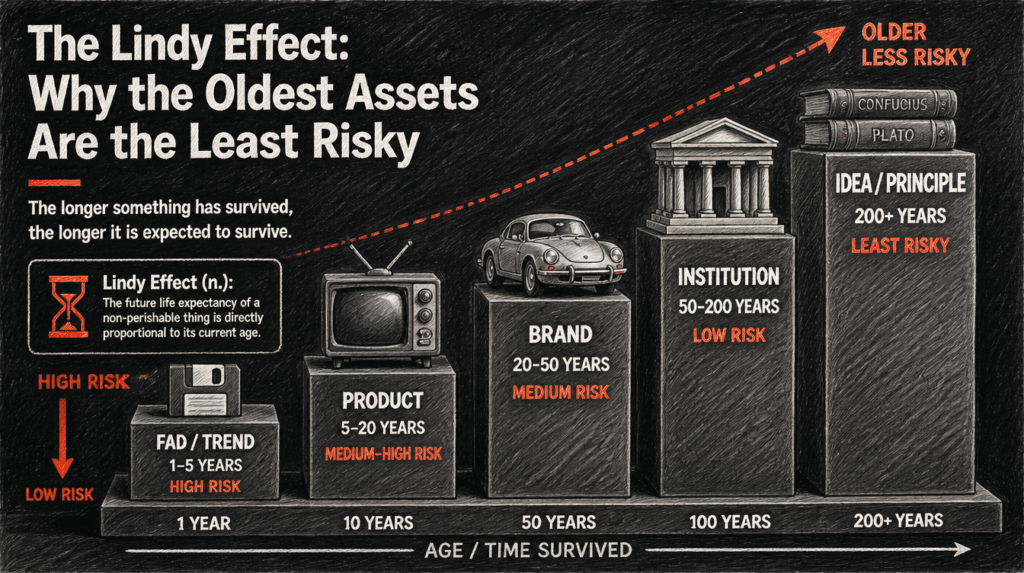
The Lindy Effect is a concept that flips your intuition about survival on its head. It says that for non perishable things like technologies, ideas, books, businesses, and yes, financial assets, every additional day of survival increases expected remaining lifespan. The longer something has lasted, the longer it is likely to last.
A book that has been in print for 50 years will probably be in print for another 50. A company that has survived for a century is more likely to survive the next decade than a company founded last Tuesday. A currency that has been trusted for 300 years carries a different kind of credibility than one launched with a whitepaper and a Discord server.
The Cemetery of Dead Innovations
To understand why old things are special, you have to understand what they have survived.
Every year, thousands of companies are born. Most die. The ones that remain after five years have passed a filter. The ones still standing after fifty years have passed a brutal gauntlet of recessions, wars, technological disruptions, management failures, competitive attacks, and sheer bad luck. Each year of survival is not just a year on the calendar. It is evidence.
Think of it like a tournament. In the first round, half the players are eliminated. In the second round, half again. By the time you reach the final rounds, the players left are not there by accident. They are there because something about their structure, their adaptability, or their fundamental value proposition keeps working.
Gold has been a store of value for roughly 5,000 years. It survived the fall of Rome, the Black Death, the invention of paper money, two world wars, and the creation of Bitcoin. At what point do we stop calling that a coincidence and start calling it a feature?
The Lindy Effect says: that point was about 4,900 years ago.
Why New Is Not Bold. New Is Just Untested.
There is a persistent myth in finance that newer means better. Newer strategies, newer asset classes, newer financial instruments. The logic sounds reasonable. Innovation improves things. Why would you use an old tool when a new one exists?
But this confuses the domain. Innovation works beautifully for technology because technology is designed to be replaced. Your phone is supposed to become obsolete. That is the business model.
Assets operate under different rules. An asset is not trying to be cutting edge. It is trying to store and grow value across time. And time is exactly what new assets have not been tested by.
When someone pitches you a novel financial product with a five year track record and a gorgeous backtest, they are showing you a player who won two rounds of the tournament and asking you to bet they will win the whole thing. Maybe they will. But the odds are not what the pitch deck suggests.
Meanwhile, boring old farmland has been generating returns since before the concept of returns existed. Nobody writes breathless articles about farmland. Nobody makes YouTube videos about it. This is precisely the point.
Nassim Taleb and the Logic of Time
The concept of the Lindy Effect was popularized by Nassim Nicholas Taleb, who built it into his broader framework of antifragility. Taleb did not invent the observation. It originally came from a deli in New York called Lindy’s, where comedians would gather and observe that Broadway shows which had already run for a long time tended to run for even longer.
But Taleb gave it teeth. He connected the Lindy Effect to a deeper truth about complex systems: time is the most ruthless and honest filter we have. Peer review can be gamed. Ratings can be bought. Track records can be manufactured through survivorship bias and creative accounting. But time does not care about your marketing budget.
If something has survived a long time in a competitive environment, it contains embedded information that you cannot fully see or articulate. You do not need to understand why gold works as a store of value across millennia. The fact that it does is itself the strongest possible argument.
This is a deeply uncomfortable idea for people who believe everything must be understood before it can be trusted. But the world is full of things that work for reasons we do not completely grasp. Aspirin was used for decades before anyone understood its mechanism. Common law accumulated wisdom through centuries of case decisions long before anyone tried to write a unified legal code.
Old assets are like common law. They encode lessons that no single mind could have designed.
The Math of Fragility
Here is where it gets interesting. The Lindy Effect does not just say that old things last longer. It implies something stranger: old things are actually getting less risky over time, not more.
This runs against every instinct. Surely an asset that has been around for 100 years is “due” for a decline? Surely the probability of failure increases with age?
Not for Lindy compatible assets. For these, each passing year is not bringing them closer to death. It is pushing their expected death further into the future. A 100 year old company is less likely to fail next year than a 10 year old company is. The survival itself is the signal.
Compare this to how most people evaluate investments. They look at recent performance. They look at momentum. They look at what is exciting. These are all measures that ignore the most powerful data point available: duration of survival under pressure.
It is a bit like choosing a bridge to cross. You could pick the shiny new one that just opened, designed with the latest materials and engineering software. Or you could pick the stone bridge that has carried traffic for 200 years through floods, earthquakes, and armies. The new bridge might be better. But if your life depends on the crossing, the old bridge has made an argument the new one simply cannot.
Where Lindy Breaks (And Where People Pretend It Does Not)
No mental model works everywhere, and the Lindy Effect is no exception. It applies to non perishable things in competitive environments. It does not apply to everything humans slap the label “asset” onto.
A specific piece of real estate, for example, can be destroyed by a natural disaster regardless of how long it has existed. A government bond is only as durable as the government behind it, and governments do fall. Lehman Brothers was 158 years old when it collapsed.
So the Lindy Effect is not a guarantee. It is a prior. It tells you where to set your baseline expectation before looking at other evidence. A 158 year old bank is not immortal, but it is a better starting bet than a 5 year old fintech startup, all else being equal.
The key distinction is between the category and the specific instance. Banking as a concept is extremely Lindy. It has existed for thousands of years and will almost certainly exist for thousands more. A specific bank, however, can still fail. Gold as a store of value is Lindy. A specific gold mining company is not.
Knowing where to draw this line is most of the skill.
What This Means for How You Think About Risk
If you take the Lindy Effect seriously, it rearranges your entire relationship with risk.
First, it suggests that the conventional wisdom of “higher risk, higher reward” is often applied backwards. People treat old, boring, time tested assets as low return and therefore uninteresting. But the Lindy lens says these assets have already been de risked by time. Their boringness is not a bug. It is the residue of having survived everything the world has thrown at them.
Second, it means that novelty should carry a risk premium that most people do not charge. When you invest in something new, you are not just accepting normal market risk. You are accepting the risk that this thing has not been filtered by time. You are volunteering to be part of the tournament’s early rounds, where the elimination rate is highest.
Third, and this is the part that matters most for building durable wealth, it shifts your attention from prediction to selection. You do not need to predict the future if you select assets that have already demonstrated an ability to survive many different futures. The past is not a guarantee, but it is the best filter available. Certainly better than a pitch deck.
The Patience Premium
There is a reason so few people actually follow Lindy thinking in practice, even when they agree with it intellectually. It is boring. It is slow. It does not give you anything to talk about at dinner parties.
Nobody becomes a legend by saying “I bought the same things my grandfather bought and then I waited.” But an awful lot of people become quietly wealthy that way.
The financial world is designed to make you feel like you are missing out. Every new product, every new trend, every new asset class comes wrapped in urgency. Act now. Get in early. This is the future.
Maybe it is. But the Lindy Effect gently reminds you that most “futures” do not arrive. The things that will matter in 30 years are, statistically speaking, the things that already mattered 30 years ago. Not all of them. But more of them than the breathless headlines would have you believe.
The oldest assets are not relics of a past world. They are proof of what survives when worlds change. And in a universe full of uncertainty, that proof is worth more than any projection.