Table of Contents
Imagine a quiet library. A man in reading glasses is halfway through a two hundred page annual report, circling footnotes about inventory accounting. He has owned this stock for three years. He bought it because nobody wanted it, which to him was the entire point. The price is low, the business is boring, and the market has forgotten it exists. This is his idea of a good time.
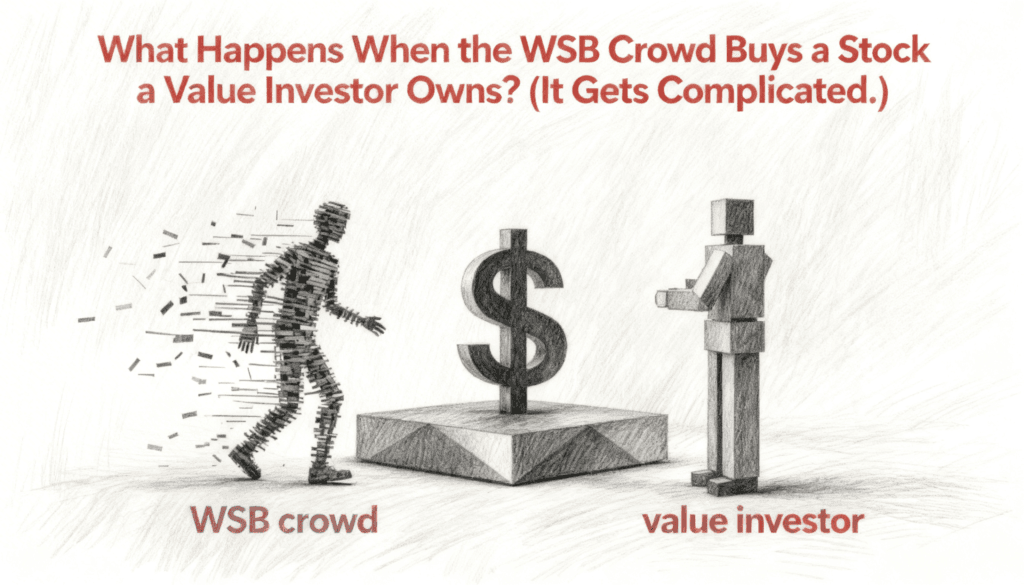
Then the doors blow open. A crowd pours in wearing rocket costumes, throwing confetti, chanting the ticker symbol like a football anthem. They have discovered his stock. They do not know what it makes. They do not care. Someone posted a screenshot, someone else posted a meme, and now the price is doing things the value investor did not forecast in any of his spreadsheets.
He should be thrilled. The stock is going up. That was the whole plan.
He is not thrilled. He is deeply, quietly, almost philosophically upset. And that reaction, more than anything else, reveals what value investing actually is underneath the math.
The Trade That Worked for the Wrong Reasons
Value investing is sold to beginners as a strategy about numbers. Find cheap companies. Wait. Get rich. The textbook version makes it sound like a careful form of bargain hunting, the investing equivalent of finding a good couch at an estate sale.
The reality is closer to a religion about patience. The value investor does not just want to make money. He wants to make money in a specific way, for specific reasons, on a specific timeline. He wants the market to eventually agree with his analysis. He wants the price to rise because the business got better, or because other serious people finally read the same footnotes he read. The gain is supposed to be a confirmation, not a coincidence.
When WSB pushes the stock up, the gain arrives without the confirmation. The price moved, but the reason did not. It is like training for a marathon for three years and then getting carried across the finish line by a crowd of strangers who thought it would be funny. Technically you finished. Technically you won. But something about it feels wrong in a way that is hard to put into words.
This is the first complication. A value investor does not only care about the destination. He cares about the road.
Borrowed Conviction Is Not Conviction
There is a concept in philosophy that gets very little airtime in finance but probably should. It is the difference between knowing something and merely being correct about it. A student who guesses the right answer on a test has the same score as the student who understood the material. But one of them will be able to answer the next question, and the other will not.
Value investors build their positions on a specific kind of knowing. They have a thesis. They have reasons. They have a range of outcomes they consider reasonable. When the price moves in their favor for reasons that match the thesis, their conviction grows. When the price moves against them, they can check their reasoning and decide whether they were wrong or whether the market is just being slow.
A WSB driven rally breaks this whole system. The price is now doing something the thesis did not predict. The value investor is now holding a position that has drifted away from his reasons. He has profits he did not earn through analysis. He has gains he cannot explain using his own framework. He is, in a strange way, trading blind, even though nothing about his behavior has changed.
The uncomfortable truth is that a stock can move in the direction you wanted for reasons that have nothing to do with you being right. And when that happens, you are no longer in the trade you thought you were in. You are in a different trade, wearing the costume of the old one.
The Sell Question Nobody Prepared Him For
Here is where it actually gets complicated. The value investor now has to make a decision he did not plan for.
His original plan was to hold the stock until the market finally recognized its true worth, which he had estimated at some level higher than where he bought it. The plan assumed a slow convergence. A boring reveal. Maybe a good earnings report, a new contract, an activist investor showing up, something that would pull the price toward the value over a year or two.
Instead, the price is already there. Or past it. In a week. For no reason the plan accounted for.
Does he sell? If he sticks to his discipline, the answer is obvious. The price has reached or exceeded his estimate of value. The whole point was to buy low and sell when the market catches up. The market caught up in a bizarre way, but it caught up. Take the win.
But now he has a different problem. He is selling into a crowd that might push the price even higher. If he sells and it doubles again, he will look like the person who left the party at ten. If he holds and it crashes back to reality, he will look like the person who got greedy and forgot his own rules. Both outcomes damage something. One damages his bank account. The other damages his self image as a disciplined investor. And for a lot of value people, the self image is the thing that keeps the whole practice together.
This is the part the textbooks do not cover. Value investing is emotionally sustainable only when the market moves at a certain speed. Speed it up too much and the psychology stops working.
Two Clocks in the Same Room
There is something almost comic about the mismatch. Value investors operate on what you could call geological time. Businesses compound. Margins improve. Management changes. These things take years. The value investor has made peace with slowness because slowness is his advantage. Most people cannot sit still long enough to collect the reward. He can.
WSB operates on weather time. Things change by the hour. A stock can be a meme by Tuesday and forgotten by Friday. Attention is the asset, and attention has a half life measured in days. The WSB trader is not betting on what a company will earn in five years. He is betting on what a crowd will feel about a ticker in five hours.
When these two clocks end up measuring the same stock, neither one is wrong. They are just reading different machines. The value investor sees a slow moving story interrupted by noise. The WSB trader sees a fast moving story that happens to involve a company he does not need to understand. Each thinks the other is playing the wrong game on the right board.
The quiet joke is that for a few weeks, they are on the same team. Their positions move together. Their profits climb together. And they would each rather lose money than admit the other one helped.
The Thing Nobody Wants to Say
Here is the contrarian part, offered gently. Sometimes the WSB rally is actually right. Not right for the reasons they think, but right. A forgotten stock getting attention can cause real changes. Analysts start covering it. Institutions take a look. Management finds a sudden interest in talking to shareholders. The attention itself can shake loose the value the value investor was waiting for.
In those rare cases, the meme crowd accidentally did the work of an activist investor, just with worse grammar and better jokes. The value investor will never admit this out loud. Admitting it would suggest that his careful process and their chaotic enthusiasm arrived at the same destination through completely different doors. And if that is true, then the process might be less essential than he thought.
That is a thought most value investors will not let themselves finish.
What the Clash Is Really About
Strip away the strategies and what you have is a disagreement about where returns are supposed to come from. The value investor believes returns should be earned through insight. You see what others do not see, you wait for them to see it, and the market pays you for being early. The WSB trader believes returns come from being in the right place when something happens. You do not need to see anything. You need to show up.
One view treats the market as a test of understanding. The other treats it as a lottery you can influence by showing up with friends.
When these two groups end up owning the same stock, the value investor feels like his exam answers got graded by someone who was not even in the class. The profits are real. The satisfaction is not. And that is the part he cannot explain to anyone who does not already feel it.
In the end, both walk away with money or without it, and the market does not care which story either of them told themselves. The ticker does not know who owns it. But the people who own it very much want the ticker to mean something, and they cannot agree on what.
That disagreement, not the profits, is the real trade.