Table of Contents
Here is a question nobody asks at finance conferences: what if money was not invented to make trade easier? What if it was invented to prevent murder?
The standard story goes like this. Once upon a time, people bartered. Bartering was inefficient. So someone invented coins, and commerce was born. It is a clean narrative. It is also, according to a growing body of anthropological evidence, incomplete.
The real origin story is far more interesting. And far more violent.
Blood Debts Before Balance Sheets
In early human societies, the biggest economic problem was not how to buy a cow. It was how to stop a killing from turning into an endless cycle of revenge.
Picture a small agricultural community, maybe 200 people. Someone kills someone else. The victim’s family wants justice, which in practical terms means they want to kill someone from the murderer’s family. That family then wants revenge in return. Within a generation, half the village is dead. This was not a theoretical risk. It was the default outcome.
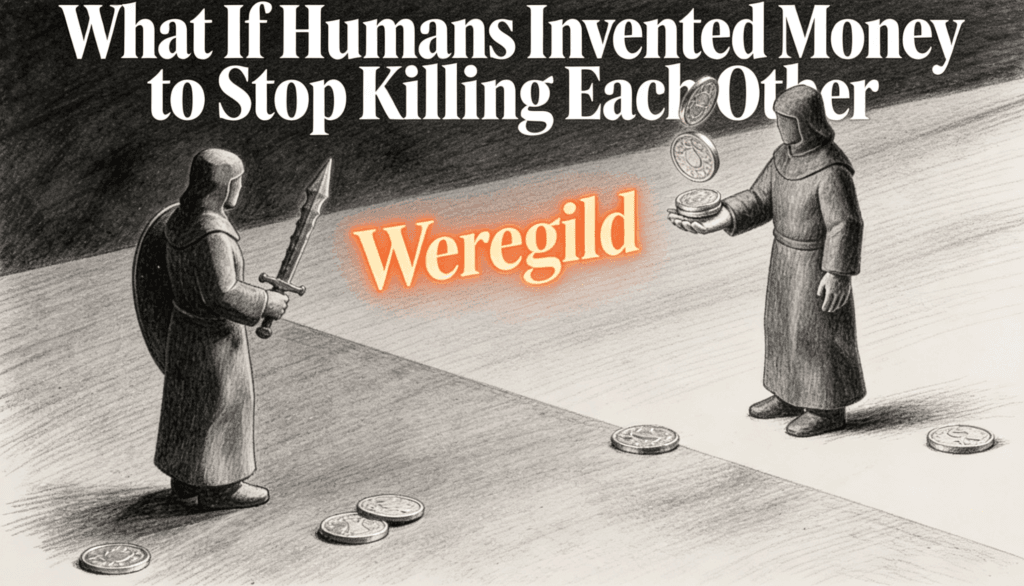
So societies across the world, independently and repeatedly, arrived at the same radical idea. What if, instead of killing back, the murderer’s family could pay? What if a human life could be assigned a value, and that value could be transferred to make the debt whole?
This is wergild. The word is Old English, literally meaning “man payment.” And versions of it existed in ancient Ireland, pre Islamic Arabia, indigenous societies across Africa and the Pacific, and dozens of other cultures that had no contact with each other. The convergence is remarkable. It suggests this was not a quirky cultural invention but something closer to a universal human discovery.
Pricing a Person
The mechanics of wergild are fascinating because they reveal how early humans thought about value in ways that would make modern economists uncomfortable.
In Anglo Saxon England, the wergild for a nobleman was 1,200 shillings. For a common freeman, 200. For a serf, less. In early Irish law, the “honor price” varied not just by rank but by profession, with poets commanding surprisingly high valuations. Apparently, even in the sixth century, people understood the economic value of content creation.
But here is what matters. These were not market prices. Nobody was buying and selling people. These were compensation schedules designed to make violence expensive enough to discourage, and structured enough to satisfy the injured party without further bloodshed.
This is a profoundly different origin for the concept of “price” than what economics textbooks describe. Price did not emerge from supply and demand in a marketplace. It emerged from the need to quantify something that is, philosophically, unquantifiable: the value of a human life.
And we still do this today. Insurance companies, courts, and government agencies all assign dollar values to human lives. The US Department of Transportation currently uses a figure around $13.7 million. We just do not call it wergild anymore. We call it the “value of a statistical life,” which sounds much more civilized.
The Unit of Account Problem
Here is where the story connects to money as we know it.
For wergild to work, you needed a unit of measurement. You could not just say “pay the family a lot.” You needed specific amounts in specific things. Cattle were common. So were measures of grain, pieces of metal, and certain types of cloth.
But notice what just happened. To prevent violence, societies needed a standardized unit of value. They needed something everyone agreed represented a certain worth. They needed, in other words, money. Not money for buying things. Money for keeping score in a system designed to prevent cycles of revenge killing.
This is the insight that anthropologist David Graeber spent 500 pages exploring in his book “Debt: The First 5,000 Years.” The earliest recorded uses of money are overwhelmingly about debt, obligation, and compensation. Not about buying sandals at the market.
The implications for how we think about finance are enormous. If money originated as a tool for managing social violence rather than facilitating trade, then the entire framework of modern economics rests on a creation myth. Not a lie exactly, but a story we tell ourselves because it is simpler and more flattering than the truth.
Why This Matters for Modern Finance
You might wonder why any of this matters to someone managing a portfolio or running a business in 2026. The answer is that origin stories shape assumptions, and assumptions shape systems.
The trade origin story implies that money is fundamentally neutral. It is just a tool, a lubricant for exchange, morally inert. This assumption underpins most of modern financial theory. Markets are efficient. Prices contain information. Money has no memory and carries no moral weight.
The wergild origin story implies something very different. It says money was born as a technology for managing conflict, power, and social obligation. Money was never neutral. It was always about relationships between people, specifically about preventing those relationships from turning lethal.
Consider how this reframes some familiar financial concepts.
Debt is not just a financial instrument. It is the original social technology. Cultures that developed robust debt systems (ways to owe, ways to repay, ways to forgive) tended to survive. Cultures that did not tended to destroy themselves. This might explain why bankruptcy law, which is essentially a system for forgiving debts, exists in every developed economy. It is not soft heartedness. It is institutional memory of what happens when debts become unpayable and people start reaching for weapons instead of calculators.
Interest rates are not just the “price of money.” They are a measure of social trust. When rates are low, it means lenders believe the social fabric is strong enough that borrowers will repay voluntarily. When rates spike, it often signals that the social contract is fraying. This is exactly what happens during financial crises, and it is why central banks treat rising rates during a crisis as an emergency. They are not just worried about economics. They are worried about the social order that makes economics possible.
The Uncomfortable Implications
If the wergild theory is correct, or even partially correct, it raises some uncomfortable questions about the modern financial system.
First, it means that when people complain about “putting a price on everything,” they are actually complaining about one of humanity’s oldest and most successful peace technologies. The alternative to putting a price on things is not some purer, less commercial world. The alternative, historically, is blood feuds.
Second, it suggests that financial crises are dangerous not primarily because people lose money, but because they disrupt the social mechanism that prevents violence. This is why every serious financial crisis in history has been accompanied by political instability, and why governments will do almost anything to prevent financial system collapse. They are not protecting the banks. They are protecting the peace.
Third, and most provocatively, it means that the moral discomfort many people feel about money and finance may be baked into money’s very DNA. Money was invented to substitute for something terrible. It carries that weight. When someone says “money is the root of all evil,” they have it backwards. Money is the root of considerably less evil. That was the whole point.
The Forgetting
Perhaps the most interesting aspect of the wergild theory is how thoroughly it has been forgotten.
By the time Adam Smith wrote “The Wealth of Nations” in 1776, the barter origin story was already dominant. Smith was brilliant, but he was also a product of the Enlightenment, which preferred clean rational explanations over messy anthropological ones. The idea that money emerged from rational actors optimizing trade was far more appealing than the idea that money emerged from desperate communities trying to prevent cycles of revenge killing.
And so we forgot. We built our economic theories on the barter myth. We taught generations of students that money is a medium of exchange, a store of value, a unit of account. All true, but all incomplete. Like describing a hospital as “a building with beds” and leaving out the part about disease and death that made the building necessary.
The wergild theory does not invalidate modern economics. Markets do function. Prices do carry information. Trade does benefit from a common medium of exchange. But it adds a dimension that is almost entirely missing from how we think and talk about money.
Money is a peace treaty. Every dollar, euro, and yen is a descendant of the first crude payments offered to a grieving family to prevent them from picking up a weapon. Every financial transaction carries an echo, however faint, of that original bargain: we will measure and transfer value in symbols, so we do not have to measure and transfer it in blood.
That is a more complicated story than the one in the textbooks. It is also a truer one. And in a world where financial systems are under more stress than at any point in recent memory, understanding what money actually is, and what it was invented to prevent, might be more than an intellectual exercise.
It might be the most practical insight in finance.