Table of Contents
The Oldest Asset Class Meets the Newest One
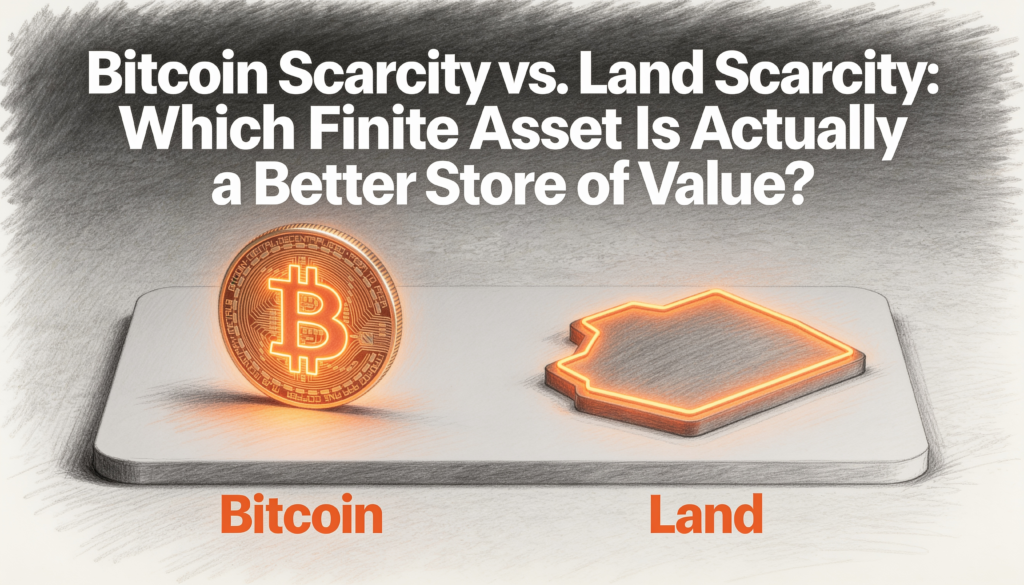
There is an old joke about real estate that has survived for generations. They are not making any more of it. That single line is supposed to explain, in one breath, why buying dirt has been a reliable path to wealth for roughly ten thousand years. Land is finite. People are not. Therefore land wins, pour the concrete, collect the rent, and never look back. Then the cryptocurrency people arrived and said something that sounded absurd at first. They said the same thing, but about code.
This is where the real debate about Bitcoin scarcity versus land scarcity begins, and it is far more interesting than a simple argument about which asset returned more last year. When you ask which finite asset is actually a better store of value, you are not really asking about price charts. You are asking what scarcity even means, and whether a few lines of software can hold purchasing power the way a beachfront lot in Malibu has for a century. The real estate crowd laughed at the idea. Then Bitcoin reached numbers that were difficult to laugh at. Then they stopped laughing and started arguing.
Land is the original investment. Before there were stocks, before there were bonds, before anyone thought to securitize a mortgage, there was dirt, and the people who owned the dirt were the people who ran everything. Empires rose and fell over it. Wars were fought for it. Entire legal systems exist mostly to clarify who is allowed to stand on which parts of it. Real estate investors inherit this long memory, and when they say land holds value, they are not making a prediction. They are citing ten thousand years of human behavior.
Cryptocurrency is the opposite of this in nearly every way. It is barely older than a teenager. It has no physical form. It exists because enough computers agree that it does, and if those computers stopped agreeing tomorrow, it would vanish like a dream. For the real estate investor, this is laughable. For the Bitcoin investor, this is precisely the point.
What Counts as Scarce: The Economics of Two Finite Assets
The real argument between these two tribes is about the definition of scarcity itself. To understand which finite asset is a stronger store of value, you have to compare them on the economic properties that actually matter: fixed supply, substitutability, portability, and divisibility. These four traits decide whether scarcity translates into durable value or simply sits there as an interesting fact.
Fixed Supply: Geographic Constraint Versus Hard Code
To the real estate investor, scarcity means something you can touch. A piece of land in a desirable neighborhood is scarce because the Earth is a sphere and neighborhoods have edges. You cannot print more of it. You cannot will it into existence. If you want it, you must buy it from someone who already owns it, and if they refuse to sell, you are out of luck. This is the kind of scarcity that feels real in the deepest sense of the word, because you can walk on it.
To the Bitcoin investor, scarcity means something enforced by rules that nobody can break. Bitcoin is capped at twenty one million coins, not because the Earth ran out of anything, but because the protocol says so, and that protocol is distributed across so many machines that altering it is effectively impossible. They argue this is a purer form of scarcity than land. After all, the supply of land is not as fixed as it appears. Humans reclaim coastlines, build upward into vertical cities, and develop previously useless terrain. A swamp becomes Manhattan. A desert becomes Dubai. The usable supply of land expands with technology, while the supply of Bitcoin does not move at all.
Land has a fixed surface but an elastic supply of usable space. Bitcoin has a fixed supply that no engineering breakthrough can ever expand. One scarcity is geographic. The other is mathematical.
Substitutability: Why No Two Plots Are the Same
Here the two assets diverge sharply, and the difference matters enormously for anyone treating them as money. Land is not substitutable. An acre in rural Kansas is not interchangeable with an acre in central London. Each parcel is unique in location, zoning, soil, view, and a thousand other variables. This non substitutability is what makes real estate valuation slow, illiquid, and dependent on appraisers, brokers, and local knowledge.
Bitcoin is the most substitutable asset humans have ever created. One Bitcoin is identical to every other Bitcoin. There is no premium for a Bitcoin with a nice view or a Bitcoin in a good school district. This perfect fungibility is exactly the quality that classical economists demanded of sound money. Gold has it. Land does not. The uniqueness that makes real estate emotionally satisfying is the same uniqueness that makes it a clumsy medium of exchange.
Portability and Divisibility: The Practical Edge
On portability, the comparison is not close. You cannot carry a building across a border in your memory. You cannot flee a collapsing regime with your apartment block. Land is the least portable asset in existence, which historically made it the easiest thing for governments to tax, seize, and redistribute. Bitcoin, by contrast, can be moved anywhere on Earth in minutes, and a private key can be memorized as twelve words and carried across any frontier without detection.
Divisibility tells a similar story. A single plot of land cannot be cut into a thousand pieces without destroying its function and its value. Bitcoin is divisible to one hundred million units, called satoshis, which means it can serve a transaction worth a fraction of a cent or a transfer worth millions with equal ease. For a store of value that doubles as a settlement system, portability and divisibility are decisive advantages that land cannot replicate.
And yet both sides have a blind spot. The real estate crowd forgets that their scarcity depends on institutions that can fail. The Bitcoin crowd forgets that their scarcity depends on belief networks that can evaporate. A title deed and a private key are both, in the end, just promises. One is written on paper and backed by a government. The other is written in code and backed by consensus. Neither is as eternal as its loudest fans pretend.
The Philosophy Hiding Inside an Economic Argument
This is where the fight becomes genuinely interesting, because it touches a question philosophers have chewed on for centuries. What makes something real? If you are a materialist, you believe reality is stuff. Atoms, molecules, land, buildings, things you can stub your toe on. Under this view, real estate is the serious asset and Bitcoin is a mass hallucination with a price chart attached.
If you lean toward the idealist position, you believe reality is shaped by shared agreement. Money itself is an agreement. Countries are agreements. Corporations are agreements. None of these things would survive if people simply stopped believing in them. Under this view, Bitcoin is not stranger than traditional assets. It is merely more honest about what it is. A house has value because people agree it does. Bitcoin has value because people agree it does. The only difference is that one of them admits it openly.
Value is not a property of things. It is a property of agreements. And agreements, like everything else in finance, are subject to change without notice.
There is a strange parallel here to the art world. For centuries people argued about whether a painting was valuable because of the physical object or because of the idea behind it. When Marcel Duchamp placed a urinal in a gallery and called it art, he was making the same argument the Bitcoin people are making now. The value is not in the thing. The value is in the agreement about the thing.
Real estate investors are the classicists of finance. Bitcoin investors are the conceptual artists. Both sides sell their work for millions, and both sides insist the other side is deluded.
The Yield Problem and the Cost of Holding
Here is where the Bitcoin camp runs into genuine trouble, and where the real estate camp quietly smiles. Land does something. It grows crops. It hosts buildings. It shelters people. Even when a parcel just sits there, it can be rented, farmed, drilled, or developed. Real estate produces yield in the most literal sense of the word. You can live inside it. You can run a business from it. You can extract something useful from it beyond the hope that someone will pay more later.
Most Bitcoin does not do this. Bitcoin does not generate anything. It does not house anyone. It does not pay a dividend or produce a harvest. Its value comes almost entirely from the belief that its value will continue. This is the real estate investor’s strongest economic card. Whatever you think about price volatility, land performs work for you while you own it. Bitcoin simply waits on a blockchain for someone to decide it is worth more.
The Hidden Carrying Costs of Land
The Bitcoin investor has a sharp rebuttal, and it begins with the costs nobody mentions at the dinner party. Land produces yield, yes, but it also produces obligations. You pay property taxes every single year, forever, whether the asset appreciates or not. In many jurisdictions that annual tax alone consumes one to two percent of the value, which means a government holds a permanent, inflation adjusted claim on your supposedly private property. You pay for maintenance, insurance, repairs, and management. You cannot ignore a leaking roof. You cannot ignore a tenant who stops paying.
Bitcoin has no carrying cost in this sense. There is no annual tax simply for holding it. There is no roof to repair and no tenant to evict. The cost of storage is the cost of securing a private key, which approaches zero. When you subtract the carrying costs of land from its yield, the gap between the two assets narrows considerably. The yield on real estate is real, but a meaningful portion of it is consumed by the very obligations that ownership creates.
The Gold Precedent
The Bitcoin investor then reaches for the strongest historical comparison available. Gold does not produce yield either. Gold grows no crops, houses no one, and pays no dividend. Yet humans have treated gold as a store of value for thousands of years across every civilization that ever mined it. The question, the Bitcoin investor argues, is not whether an asset produces yield. The question is whether it holds purchasing power across time. Gold does. The bet is that Bitcoin, being scarcer, more portable, and more divisible than gold, will do the same job better. The wager is about durability, not utility.
Which Finite Asset Is Actually the Better Store of Value?
The honest answer is that both sides are describing real properties that matter, and both sides overstate their case. Land will probably keep holding value because humans will probably keep needing somewhere to stand. But real estate is not a sure thing. Cities decline. Climates shift. Entire regions become uninsurable as flood and fire risk rises. The idea that land is eternal is a comforting story that stops being true the moment the story around the land changes. A mansion in a town nobody wants to live in is worth almost nothing, no matter how scarce the dirt beneath it.
Bitcoin might keep holding value because humans might keep agreeing that digital scarcity matters. But Bitcoin is not a sure thing either. Networks can split. Competitors can emerge. A technology that looks permanent in this decade might look quaint in fifty years. The claim that code is the new land depends entirely on whether the belief network survives long enough to become tradition.
Both assets depend on collective belief. Both can be taken from you under the right circumstances. Both reward patience and punish panic. The difference is that one belief is anchored in physical place and the other in pure mathematics.
When you weigh the economic traits directly, a clearer picture emerges. On portability, divisibility, substitutability, and absolute supply rigidity, Bitcoin holds a structural advantage that land cannot overcome.
On yield, durability of demand, and a track record measured in millennia rather than years, land holds an advantage that Bitcoin has not yet earned. A reasonable investor does not crown a single winner. A reasonable investor notices that these two assets hedge against entirely different failures. Land protects you against the failure of digital systems. Bitcoin protects you against the failure of physical jurisdictions. Owning both is not indecision. It is recognition that the future has more than one way of going wrong.
The Quiet Lesson Underneath the Noise
If you zoom out far enough, the fight between these two tribes looks less like a disagreement and more like a conversation the species has been having with itself for a very long time. Every generation discovers a new thing that feels permanent. Gold. Land. Stocks. Bonds. Code. Each time, people insist that this one is different, and each time the next generation decides that something else matters more. The assets that survive are not the ones that promise eternity. They are the ones that adapt to whatever the next generation decides to value.
So perhaps the real estate investor and the Bitcoin investor are both asking the wrong question. The question is not which finite asset will hold value forever, because nothing holds value forever. The question is which one will still be valued in the specific future you are actually planning for. If you fear digital collapse, surveillance, and the fragility of networks, land is your fortress. If you fear capital controls, currency debasement, and the seizure of immovable property, Bitcoin is your escape hatch. Both fears are legitimate. Both have happened to real people in living memory.
The dirt people and the code people will keep shouting at each other online, each convinced the other has misunderstood the nature of value. The rest of us can watch, take notes, and quietly build a position in whichever finite asset matches the world we expect to inherit. Scarcity alone is never enough. Scarcity only becomes wealth when human beings keep agreeing that the scarce thing is worth wanting, and that agreement, in dirt or in code, is the only thing either asset has ever truly been made of.