Table of Contents
The Question Nobody Wants to Say Out Loud
There is a particular kind of person who spends fifteen years tracking every coffee purchase in a spreadsheet, maxing out retirement accounts, driving a used Toyota, and quietly building a FIRE portfolio that will one day let them walk away from work forever. And there is another particular kind of person who, during a single Tuesday afternoon, bets most of their savings on call options for a company they first heard about that morning, watches the screen for three hours, and either retires at twenty six or starts over at twenty six.
These two people would not enjoy dinner together. But the strangest thing about them is not how different they are. It is that they are both trying to answer the exact same question, and they have come to wildly different conclusions about what the correct answer even looks like. The real provocation, the one almost nobody in the financial independence community will say out loud, is whether a small dose of the second person could actually make the first person free sooner.
The question underneath both of them is this. How much of your finite life are you willing to trade for financial freedom, and how certain do you need to be that the trade will actually work?
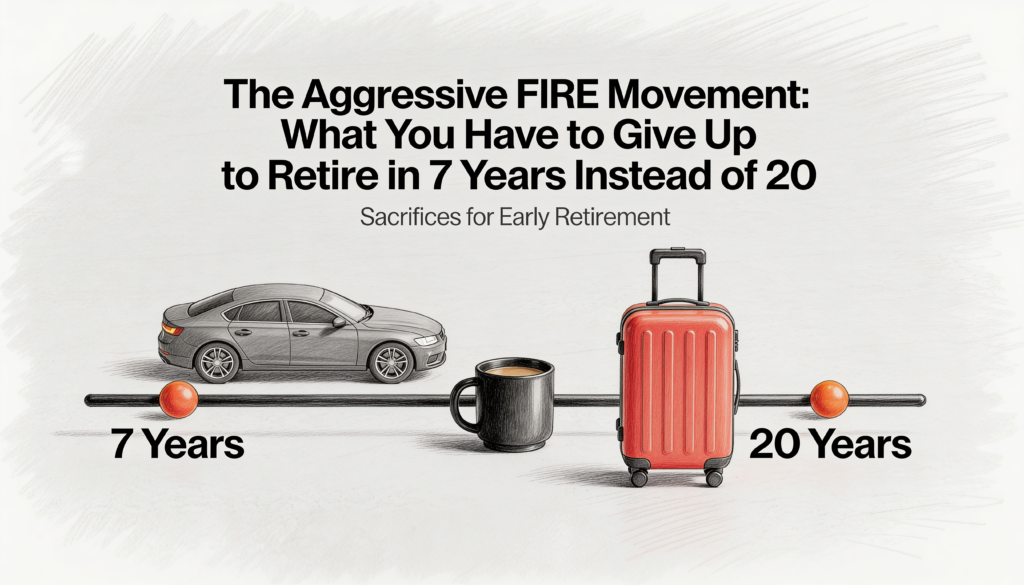
FIRE people have answered this with a very specific formula. They will trade a large amount of time, say seven to twenty years of disciplined saving, in exchange for a very high probability of success. The math is boring on purpose. Index funds. Savings rates. The four percent rule. Everything is designed to remove luck from the equation as much as possible. If you do the things, and you keep doing the things, the outcome bends in your favor. Slowly. Predictably. Almost insultingly so.
WallStreetBets people have answered the same question in reverse. They will trade a small amount of time, say an afternoon or a week, in exchange for a very low probability of success but an enormous payout if it hits. Their math is not boring. Their math is barely math. It is closer to a prayer with a strike price attached to it. The outcome does not bend in their favor at all. It simply either happens or it does not, and both results are dramatic.
One group is trying to make wealth predictable. The other group is trying to make wealth possible. And the distinction matters more than either side realizes, because the uncomfortable answer to our title lives in the narrow space between those two philosophies.
The Tortoise and the Hare Are Both Lying About Their Motives
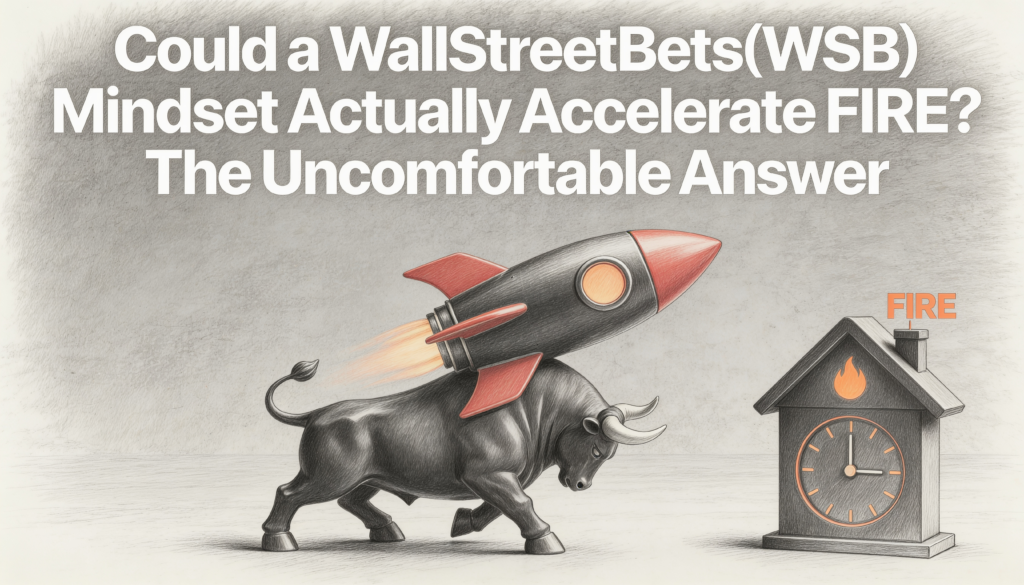
The obvious frame here is the tortoise and the hare, and it is obvious because it is almost right. The FIRE person is the tortoise, and they will happily tell you so. They wear the label like a merit badge. The WallStreetBets person is definitely the hare, though they would probably describe themselves as a rocket. But the old fable was about two animals racing toward the same finish line, and that is where the metaphor breaks.
These two are not racing toward the same thing at all. They are not even on the same track.
The FIRE person is trying to buy out the rest of their own life. They want to purchase the hours between now and death so they can spend them however they choose. Every dollar they save is a brick in a wall they are building between themselves and an employer. The goal is structural. Boring. Permanent.
The WallStreetBets person is not buying freedom. They are buying a story. They are buying the version of reality where they become the person who caught the one trade that changed everything. The money is almost incidental. What they really want is to be the exception. The screenshot. The legend in the group chat. You do not post a loss porn thread because you wanted to retire early. You post it because something about the attempt felt alive in a way that fifteen years of index fund contributions never would.
One group is debating strategy. The other group is defending a form of self expression. That is why the arguments between the two camps go nowhere. They are not even speaking the same language.
And yet, if you strip away the costumes, both of them are reaching for the same outcome with different odds. This is exactly why the question of whether a WallStreetBets mindset could accelerate a FIRE timeline is not as absurd as the spreadsheet crowd would like it to be. The hare is not wrong about the value of speed. The hare is only wrong about the dosage.
Why Speed Tempts Even the Disciplined
Anyone who has run their own FIRE projection has felt the temptation. You build the model, you plug in your savings rate, and the calculator coldly informs you that you will reach financial independence in eighteen years. Eighteen years. You are looking at the most boring number in personal finance, and somewhere in the back of your mind a small voice whispers that there has to be a faster way. That voice is the WallStreetBets mindset knocking on the door of a disciplined person. The interesting question is whether you should ever let it in, and if so, how far.
Certainty Is Also a Tax
Here is where it gets uncomfortable for the FIRE crowd. The price of near certainty is time. That is not a small price. It is, arguably, the largest price a human being can pay for anything. You are handing over the most vibrant, unrepeatable years of your existence in exchange for the assurance that the numbers will work out eventually.
And they probably will. But the trade is real, and the trade is brutal, and pretending otherwise is how people wake up at forty five with a fully funded retirement account and a quiet sense that they have been very responsible about something they can no longer remember choosing.
Discipline, taken far enough, starts to look like a different kind of gamble. You are betting that the future version of you will be around to enjoy what the present version of you gave up. You are betting that your health holds. That your relationships hold. That the world you saved for still exists in a recognizable form. These are not guaranteed either. They are just quieter risks. The kind that do not show up on a brokerage statement.
Meanwhile, the price WallStreetBets pays is the opposite. They keep their youth, their chaos, their willingness to be ridiculous in public, but they mostly keep none of their money. The probabilities are not kind. Most of them will not catch the trade. Most of them will catch several bad ones. And the story they are buying, the one where they become the exception, is a story almost none of them will ever get to tell.
The Real Math of a Small High Risk Allocation
Let us actually run the uncomfortable experiment instead of waving it away. Imagine a disciplined saver with a one hundred thousand dollar portfolio who is willing to designate five percent, or five thousand dollars, as a dedicated high risk position. The other ninety five percent stays in index funds, untouched, doing the slow and reliable work it was designed to do.
If that five thousand dollars goes to zero, the saver loses five percent of their portfolio and roughly a few months of progress. Annoying, but survivable, and the boring ninety five percent keeps compounding as if nothing happened. If that same five thousand dollars instead multiplies tenfold during a volatile market event, it becomes fifty thousand dollars, which is half of the original portfolio appearing in a single position. That is not a fantasy in the strictest sense. Concentrated bets have done exactly that during specific moments of market mania.
The asymmetry is the entire point. A small allocation can only cost you a little, but it can theoretically pay you an amount that genuinely moves your retirement date forward by years rather than months.
The honest conclusion is uncomfortable for both camps. A tiny, fixed, never replenished high risk allocation could in fact accelerate a FIRE timeline, not because it usually works, but because the downside is capped and the upside is not. The danger is never the five percent. The danger is the human inability to keep it at five percent.
What Each Side Cannot Admit
The thing FIRE cannot admit is that pure discipline without any tolerance for risk is its own kind of fear dressed up as wisdom. It is the fear of being wrong, of being embarrassed, of watching someone else get lucky and having to feel something about it. The spreadsheet is comforting partly because it tells you that you are in control. But control is a lovely illusion, and the people most devoted to it are often the ones who have the most to lose when it cracks.
The thing WallStreetBets cannot admit is that chasing the lucky trade is not actually about the money either. It is about refusing to accept a version of adulthood that feels too slow, too gray, too obedient. It is rebellion in the shape of a brokerage account. The loss porn is the giveaway. Nobody proudly posts their losses unless the losing itself is part of the identity. The pain is the dues you pay to stay in the club of people who are still playing instead of quietly compounding.
Both groups are reacting to the same underlying suspicion. That the normal path, working a job until sixty five and hoping for the best, is a slow form of surrender. FIRE says the escape is to save harder and exit early. WallStreetBets says the escape is to skip the whole thing and win the lottery. Different exits from the same building.
The Strange Middle Nobody Talks About
There is a connection here to something that happens in creative fields, and it is worth a short detour. Writers, musicians, and artists face an almost identical fork. You can treat the craft like FIRE treats investing. Show up every day. Put in the hours. Trust that the work will compound and that one day the quality will carry you somewhere real. Or you can treat it like WallStreetBets treats options. Swing for the viral hit. Make the thing that might explode. Accept that most of what you make will vanish, and bet everything on the idea that one piece will break through.
And here is the thing almost every successful creator eventually figures out. Neither approach works on its own. The pure disciplinarians produce a lot of competent work that nobody ever sees. The pure swingers burn out before they ever land the hit. The people who actually build something lasting do a weird hybrid. They show up every day like a tortoise, and then every so often, when they feel the moment is right, they take a swing that a tortoise would never take.
The same might be true for wealth. The people who do best over a lifetime are not pure FIRE and not pure WallStreetBets. They are the ones who built the boring foundation first, who earned enough certainty to have something to lose, and who then, from that position of stability, allowed themselves a small corner of their portfolio to be a little ridiculous with.
The boring foundation is not the opposite of the wild bet. The boring foundation is the only thing that makes the wild bet intelligent rather than suicidal.
Not because it is optimal. Because being entirely one thing is exhausting, and being entirely the other thing is destructive. The barbell, where the vast majority of your capital is maximally safe and a tiny sliver is maximally aggressive, is the rare strategy that honors both the patience of FIRE and the hunger of WallStreetBets without surrendering to either.
How the Hybrid Actually Behaves Over Time
The behavioral truth is that the hybrid approach can also protect the FIRE saver from themselves. A disciplined person with no outlet for risk sometimes blows up their entire plan in one panicked moment, abandoning years of saving because the urge to do something dramatic finally overwhelms them. A saver who has already given that urge a small, contained sandbox is far less likely to torch the foundation. The five percent allocation is not only a wealth accelerant. It is a pressure valve that keeps the other ninety five percent untouched.
What You Are Really Choosing
So the real question is not FIRE versus WallStreetBets. The real question is what you believe about time and luck, and whether you are honest enough to hold both beliefs at once.
If you believe time is something you can trade patiently and luck is something you cannot trust, you will become a FIRE person, and you will probably be fine. You will retire early, live modestly, and spend your fifties doing things you wish you had done in your thirties. If you believe luck is the only real force in the universe and time is too short to spend twenty years pretending otherwise, you will become a WallStreetBets person, and you will probably be broke a few times, and you might have better stories, and you will either win something enormous or you will not.
Most people are not honest enough with themselves to know which one they are. They claim to be the tortoise while secretly hoping for a lottery ticket to show up in the mail. Or they claim to be the rocket while quietly envying anyone who has a pension.
The uncomfortable answer to whether a WallStreetBets mindset could accelerate FIRE is yes, but only in homeopathic doses, and only for the person disciplined enough to keep the dose small. The mindset is poison in volume and medicine in micrograms. Almost nobody can tell the difference until they have already swallowed too much.
The wealth is not really the point. The wealth is the scoreboard. What each side is actually choosing is a relationship with uncertainty, and there is no right answer to that. There is only the answer you can live with when the market closes, the screen goes dark, and you are left sitting with whoever you decided to become. And that, more than any trade or any savings rate, is the thing that ends up mattering.