Table of Contents
How to Tell If a Financial Influencer Actually Follows Their Own Advice
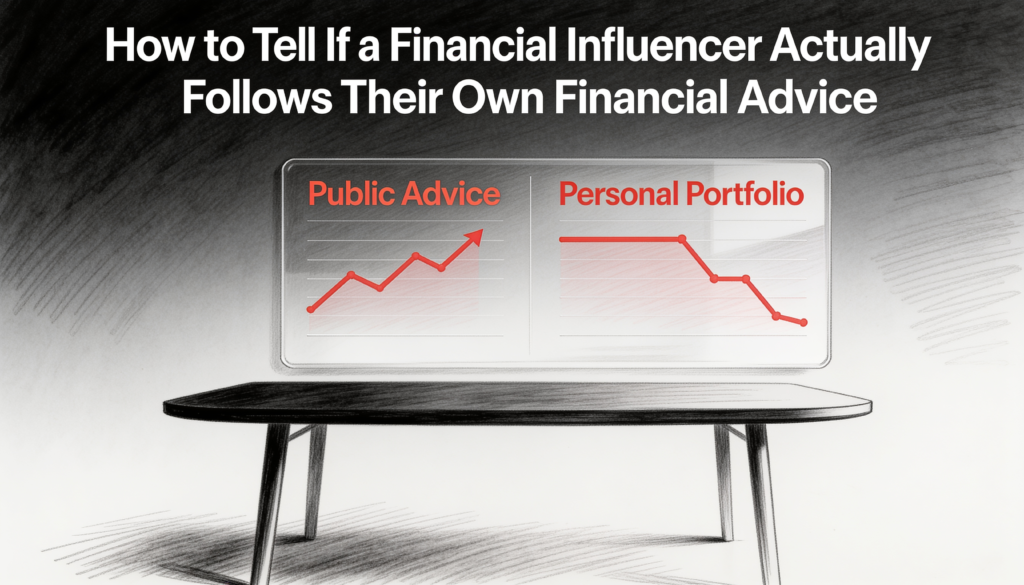
There is an unwritten rule in finance that the louder someone is about their strategy, the less likely they are to be following it. If you want to know whether a financial influencer actually follows their own advice, you do not need a forensic accountant. You need a few sharp questions and the willingness to sit with uncomfortable answers.
Crypto investors figured this out early. Not because they are smarter than anyone else, but because they come from a culture built on distrust, and when you are already suspicious of everything, noticing hypocrisy becomes a reflex. This guide turns that instinct into a practical skeptic’s checklist. The goal is simple: to help you separate creators who manage money from creators who manage attention, because the difference determines whether their advice is worth a single second of your time.
The Incentive Problem Nobody Wants to Name
Financial Twitter, or FinTwit, is full of people who sound like they have figured out the market. They post charts. They share macro takes. They offer portfolio frameworks and risk management lessons, often with the confidence of someone who has never once been wrong about anything. Crypto investors look at all of this and ask one question that tends to make the whole performance uncomfortable: if your strategy works so well, why are you selling courses about it?
It is a fair question, and the answer reveals something deeper than one community being annoyed at another. Here is the basic tension. If you have a trading strategy that consistently makes money, the rational thing to do is to trade. Quietly. Relentlessly. You would not need an audience. You would not need a newsletter. You certainly would not need to sell a seventy dollar ebook explaining the exact setup that supposedly prints money every Tuesday at market open.
The moment someone starts monetizing their financial opinions, they have introduced a second business, and the second business has different incentives than the first one. The first business, investing, rewards being right. The second business, content, rewards being interesting. These two goals overlap sometimes, but not always. And when they diverge, the content almost always wins, because content pays whether you are right or wrong.
Why Crypto Investors Spot This First
The entire crypto ecosystem was shaped by the experience of watching influencers promote tokens they were quietly dumping on their followers. The rug pull is not just a meme in crypto. It is a foundational trauma. So when crypto people see a FinTwit personality posting about the importance of disciplined value investing while simultaneously running three paid Discord channels and a merchandise line, the pattern recognition kicks in.
It is not that every FinTwit pundit is a fraud. Most are not. But the structure they operate in makes fraud and honesty look almost identical from the outside. That is the problem, and that is precisely why a practical skeptic needs concrete signals rather than vague suspicion.
The moment a creator earns more from teaching a strategy than from trading it, you are no longer their customer. You are their product.
The Specific Signals That Someone Is Monetizing Attention
Vibes are not evidence. If you want to know whether a financial influencer follows their own advice, you need a checklist of observable behaviors. The following signals are the ones that consistently separate genuine practitioners from performers. None of them is conclusive on its own. Stacked together, they tell you almost everything.
Signal One: The Wins Are Loud and the Losses Are Quiet
FinTwit is a masterclass in front stage performance. The charts are always clean. The trade recaps are always in hindsight. The lessons are always drawn from wins. When a trade goes badly, it becomes a learning experience posted three weeks later with the emotional distance of someone who has already recovered financially. You rarely see the screenshot of the loss the day it happens. You almost never see the panic.
This asymmetry in how failure is handled is the clearest tell of all. The absence of visible failure does not read as competence. It reads as editing. A genuine practitioner posts losses in real time, not as polished after the fact narratives. Scroll back through a creator’s timeline and ask yourself a single question: when did this person last show me a losing position while it was still losing? If the answer is never, you are watching a highlight reel, not a track record.
Signal Two: No Verifiable Position Disclosure
Nassim Taleb popularized the idea that you should only trust people who have something to lose from being wrong. A pundit can recommend a stock, talk about it for weeks, build an audience around the thesis, and never disclose whether they own a single share. Some do disclose, and the ones who do often frame it vaguely enough that you cannot tell if they bought a meaningful position or just enough to technically say they have exposure.
The practical test is this: can you verify the position, and is it large enough to matter relative to their net worth? In a world where transactions can be verified on a public ledger, the idea that someone would recommend an investment without proving they own it feels almost primitive. It is like a restaurant critic who will not tell you whether they actually ate the food. When a creator dodges the question of what they personally hold, treat the silence as the answer.
Signal Three: The Product Costs More Than the Strategy Earns
There is a pattern in finance that repeats across decades. Someone develops a following based on their market insights. The following grows. The insights become products. The products become the primary income. And at some point, imperceptibly, the person stops being an investor who shares ideas and becomes a media company that happens to talk about markets.
This is not necessarily dishonest, but it changes the relationship between the pundit and the audience in a way that is rarely acknowledged. When your revenue comes from subscribers, your incentive is retention, not returns. You need to sound smart every week. You need to have a take on everything. You need to make people feel like they are getting value, which often means making things sound more complicated than they are, because nobody pays for advice that says buy an index fund and wait.
Signal Four: Manufactured Complexity
The simplest financial advice is also the least profitable to sell. You cannot build a subscription empire on patience and a low cost index fund. So watch for creators who consistently make basic ideas sound exotic. If every explanation requires a proprietary indicator, a secret framework, or a paywalled tier to fully understand, the complexity is often serving the business model rather than your understanding. Real teachers simplify. Attention merchants obfuscate, because confusion sells the next course.
Signal Five: The Disappearing Trade
When a crypto investor loses everything on a leveraged trade, the replies are a mix of sympathy and dark humor. When a FinTwit pundit loses money, the trade simply disappears from the timeline. The deleted call is one of the most reliable signals available, and it is also one of the easiest to check. Save screenshots. Note the predictions. Then watch which ones quietly vanish. A creator who stands behind their losses is showing you exactly the kind of honesty about imperfection that you should demand. A creator who scrubs the record is telling you that the record was never meant to be a record at all.
You do not need to catch a creator lying. You only need to notice what they refuse to show you. The gaps in the performance are the performance.
The Counterintuitive Defense of Financial Influencers
Here is where it gets interesting. Skeptics are right to be suspicious, but they are also wrong about something important. Some of the best financial educators in the world do not manage money. They teach. And teaching is a legitimate skill that creates real value, even if the teacher could not outperform a simple index fund.
A basketball coach does not need to dunk. A writing professor does not need a bestseller. The ability to explain, synthesize, and frame ideas has worth independent of personal trading results. The mistake skeptics sometimes make is assuming that the only legitimate form of financial knowledge is the kind that shows up in a portfolio. This is like saying the only legitimate form of medical knowledge is being healthy. It confuses the practitioner with the professor, and both roles matter.
The Real Problem Is Pretending to Do Both
The real issue is not that financial influencers teach instead of trade. It is that many of them pretend to do both. They maintain the image of the active, successful trader while primarily running a content business. If they dropped the performance and simply said I am a financial educator, not a fund manager, much of the criticism would evaporate. But that admission would also reduce their perceived authority, and perceived authority is the product.
This connects to something the restaurant industry learned decades ago. The most successful food critics are not necessarily the best cooks, and the best cooks are almost never critics. The skills are different. The incentives are different. The audiences are different. Finance has not fully absorbed this lesson yet. When you evaluate a creator, the most honest version of the question is not are they a genius trader. It is are they being honest about which role they actually play.
A Practical Checklist You Can Use Today
Before you act on any financial influencer’s advice, run them through these questions. The exercise takes ten minutes and will save you far more than that.
- Do they show losses in real time? If failure only appears in polished retrospectives, you are watching a highlight reel.
- Can you verify their positions? A specific, sized, checkable holding beats a thousand confident threads.
- Where does their money actually come from? If the courses, subscriptions, and merchandise clearly outweigh any plausible trading income, they sell attention, not strategy.
- How often do they find can not miss opportunities? Constant urgency signals a retention business, not an edge.
- Do their old calls survive? Disappearing predictions reveal a record that was never meant to be kept.
- Do they admit what role they play? A creator who openly says I am an educator, not a manager has already passed the most important honesty test.
- Does their advice ever resolve to something boring? If the conclusion is never simply be patient and diversify, ask why complexity is so consistently profitable for them.
No single answer condemns a creator. A pattern of them does. Use the checklist to grade behavior over time rather than to deliver a verdict in a single sitting.
The Bottom Line Nobody Wants to Hear
Most financial advice, regardless of where it comes from, is worth less than the price of doing nothing and being patient. The best investors in history are not the ones who found the right guru. They are the ones who developed the ability to sit still while everyone around them was chasing the next signal, the next call, the next thread that promised to change everything.
It is right to question whether a financial influencer follows their own advice, and the signals in this guide will help you answer that question with confidence. But the deeper question is whether any of the advice, from any corner of the internet, matters as much as the simple and deeply unsexy discipline of not doing something stupid with your money.
That might be the one idea no financial subculture will ever bother to monetize, because you cannot sell a course on doing nothing. Which is exactly why, when a creator finally tells you to slow down, diversify, and wait, you might be hearing the only piece of advice they actually follow themselves.