Table of Contents
Why Trading Gurus Sell Courses Instead of Trading: The Simple Economics Behind the Guru Business Model
If a trading guru has genuinely cracked the market, why is he selling you a four hundred dollar course instead of quietly compounding his fortune in silence? This single question dismantles the entire trading guru business model faster than any losing trade ever could. The answer is not that gurus are all frauds. The answer is far more interesting and far more uncomfortable. It is simple economics.
This article does something most discussions of trading gurus avoid. Instead of asking whether the guru is a liar, we are going to do the math. We are going to treat the guru as a rational business operator and calculate, honestly, why selling courses produces more reliable income than trading a personal account, even for a person who is genuinely skilled at reading markets. When you finish, you will never look at a Financial Twitter trade alert or a YouTube trading mentor the same way again.
The Paradox of Shared Alpha
In finance, an edge is only an edge for as long as not everyone knows about it. This is not abstract theory. It is a basic mechanical truth about how markets function. If one hundred people discover the same opportunity at the same moment, the opportunity collapses before most of them can act on it. Prices adjust. The window closes. Competition erases the advantage.
So when a person posts a trade idea to fifty thousand followers, something does not add up. Either the idea is genuinely good, in which case broadcasting it erodes the very advantage being advertised, or the idea is mediocre and the real product is not the trade at all. The real product is the audience watching the trade.
Most of the time it is the second thing. This is not cynicism. It is structure. The moment a trader builds a large enough following, the incentives quietly rotate. The followers become more valuable than the positions. Subscriptions, courses, Discord memberships, and affiliate links generate steadier income than any chart setup ever will. The trading slowly transforms into a marketing instrument for the business of appearing to trade well.
An edge that is broadcast to a crowd stops being an edge. The only thing that scales when you share a trade with fifty thousand people is the size of your audience, not the size of your returns.
Consider professional cooking shows. The best chefs in the world are not on television. They are in their kitchens doing the work. The chefs on television are extraordinarily good at being on television. Sometimes they are also good cooks. But the skill that puts a person on camera is not the same skill that produces a perfect plate of food. Gordon Ramsay and others are exceptions to the rule. The trading guru economy works identically. The skill that builds a following is not the same skill that builds a portfolio.
The Economics Nobody Wants to Calculate
Let us actually run the numbers, because this is where the guru business model becomes undeniable. Imagine a genuinely talented trader. Not a fraud. A real, skilled operator who can produce twenty percent annual returns, which would place him among the best in the world over any sustained period. Most professional fund managers cannot do this consistently.
The Trading Path
Suppose this trader has built a personal account of one hundred thousand dollars, which is a meaningful sum for a retail operator. At twenty percent annual returns, he earns twenty thousand dollars in a year. That is a spectacular return on capital. But it is twenty thousand dollars of income, and it required full time screen attention, enormous psychological strain, and exposure to the very real possibility of a drawdown that wipes out several years of gains in a single bad quarter.
Here is the cruel part of trading economics. Returns are constrained by capital. To earn one hundred thousand dollars from trading at twenty percent, the trader needs five hundred thousand dollars of capital at risk. To earn one million dollars, he needs five million dollars at risk. The income scales only as fast as the account grows, and the account grows slowly, because compounding takes years and every drawdown resets the clock. Worse, trading income is volatile. A profitable year can be followed by a flat year or a losing year, and the market does not care about the trader’s mortgage payment.
The Course Path
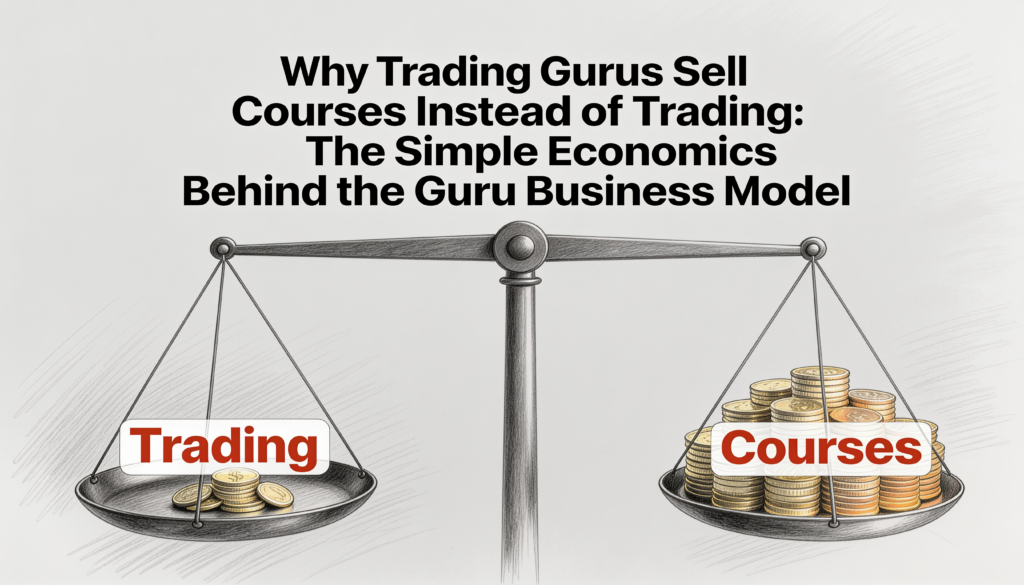
Now consider the same trader who decides to sell a course instead. He builds an audience of fifty thousand followers, which is achievable within a year or two of consistent posting. He creates a course priced at three hundred dollars. If just two percent of his audience buys it, that is one thousand sales, which equals three hundred thousand dollars in revenue.
Read that again. Three hundred thousand dollars. That is fifteen times the income our genuinely skilled trader earned by actually trading his hundred thousand dollar account. And the course required no capital at risk. There was no drawdown. There was no sleepless night watching a position move against him. The course sells while he sleeps, while he vacations, and while the market is closed.
A skilled trader with a hundred thousand dollar account earns twenty thousand dollars in a great year. The same person selling a course to two percent of fifty thousand followers earns three hundred thousand dollars. The math is not close. It is not even in the same universe.
Why Course Revenue Is Structurally Superior
The reason course income dominates trading income comes down to three structural advantages that have nothing to do with honesty or dishonesty.
- Course revenue is uncorrelated with market performance. A losing market month does not reduce course sales. In fact, volatile and frightening markets often increase demand for education, because frightened people search for someone who appears to have answers.
- Course revenue scales with audience, not capital. Doubling your followers can double your income overnight. Doubling your trading income requires doubling your account, which takes years and exposes twice as much money to loss.
- Course revenue carries almost no downside risk. A trade can go to zero. A digital product cannot lose money once it is created. The marginal cost of selling one more copy is effectively nothing.
This is the entire secret. Even a genuinely profitable trader is acting rationally when he pivots to selling courses, because the course business is simply a superior business. It is more reliable, more scalable, and less risky. The guru does not need to be a fraud to make this choice. He only needs to be good at mathematics.
The Day Trader’s Dilemma and the Loneliness Trade
Day trading culture has always had an uneasy relationship with transparency. The mythology centers on the lone operator with multiple screens, a fast connection, and the discipline to read price action in real time. This person does not need an audience. An audience would be a liability. Real edges in day trading tend to be fragile, time sensitive, and capacity constrained. Telling people about them is like announcing your poker hand to the entire table.
Yet day trading communities are among the most social spaces in all of finance. Chat rooms, live streams, group calls, and shared screen recordings fill the day. The contradiction hides in plain sight. If this is a solo game of skill, why does it look so much like a group activity?
The answer has less to do with strategy and more to do with psychology. Day trading is isolating. You sit alone. You make decisions under pressure. You win or lose in silence. The emotional weight of that isolation drives people toward community whether or not it helps their performance. In many cases it actively hurts performance. Research on group trading behavior consistently shows that traders in social environments take larger risks, hold losing positions longer, and trade more frequently.
The community feels supportive. The outcomes tell a different story. This is the same dynamic that appears in gambling research. Casino floors are designed to be social for a precise reason. Isolation encourages caution. Company encourages action. And action is what generates fees, commissions, and in the case of the guru economy, content that sells courses.
The Content Machine Underneath the Guru Economy
Financial Twitter and the broader guru ecosystem are not really financial communities. They are content ecosystems that use finance as raw material. The distinction matters enormously.
A financial community would be organized around outcomes. What works? What does not? How do we measure success honestly? A content ecosystem is organized around engagement. What gets shared? What starts arguments? What makes people feel something strongly enough to comment and click? These are not the same incentives, and they produce radically different kinds of information.
In an outcome driven environment, boring truths survive because they are useful. In an engagement driven environment, exciting half truths survive because they are shareable. The trader who made money on a setup posts about it loudly. The same trader who lost money on the same setup the following week says nothing. What the audience sees is a curated highlight reel presented as a track record.
Survivorship Bias at the Speed of a Feed
This is survivorship bias operating at the speed of a social media feed, and it is nearly impossible to detect from the inside. When you follow two hundred trading accounts and several of them post winning trades every single day, your brain performs the calculation incorrectly. It begins to believe that profitable day trading is normal and that the wins you see represent a realistic success rate.
They do not. You are observing the survivors and mistaking them for the entire population. The accounts that blew up and went quiet do not appear in your feed. The losses are invisible. Only the wins are broadcast, and the broadcast itself becomes the marketing funnel for the next course launch.
You are not looking at a track record. You are looking at a highlight reel edited by an algorithm that rewards excitement and deletes failure. Mistaking that highlight reel for evidence is the most expensive error in retail finance.
Who Is the Customer, and Who Is the Product?
Here the clash becomes genuinely revealing. In day trading culture, the trader is supposed to be the operator. He is the person doing the work, taking the risk, and extracting profit from the market. In the guru economy, the trader is often the product. His ideas, his personality, and his trades are the content, and the audience is the customer who pays.
These two roles cannot coexist cleanly. When you trade for yourself, your only obligation is to your own account. When you trade for an audience, your obligation splits in two. You need to be right, but you also need to be interesting. And when those two goals conflict, interesting almost always wins.
Nobody builds a following by posting “I sat in cash today because nothing looked good.” That is frequently the smartest thing a trader can do. It is also the least shareable. The result is a slow drift toward performative trading. Positions are taken partly because they make good content. Analysis is shared partly because it generates discussion. Risk is taken partly because caution does not get retweets.
The audience never requests this explicitly. The algorithm does it implicitly. Over time, the trader who started out trying to make money from the market ends up making money from the people watching him pretend to make money from the market.
This Pattern Is Not Unique to Finance
The same distortion happens in every field where expertise meets social media. Fitness influencers design workout routines for camera angles rather than results. Travel bloggers visit places based on their visual appeal rather than their actual quality. The medium reshapes the message until the original purpose becomes barely recognizable. Finance is simply the version of this pattern where the distortion costs you money directly.
The Uncomfortable Truths Both Sides Avoid
Day trading culture does not want to admit that most of its participants would be better off not trading at all. The data on this is stark and consistent. The vast majority of retail day traders lose money over any meaningful time horizon. The ones who do profit tend to do so modestly and with enormous time investment. The hourly return, when calculated honestly, is frequently worse than a regular job.
The guru economy does not want to admit that its information environment makes this problem worse rather than better. More opinions do not create more clarity. They create more noise. And noise disguised as signal is the most expensive thing in all of markets. You do not pay for it in dollars at the point of purchase. You pay for it in bad decisions that feel well researched because you read seventeen threads before pulling the trigger.
The irony is sharp. The communities that talk the most about edge and alpha are often the ones most systematically destroying both. Every shared idea, every public thesis, and every broadcast setup compresses the very advantage being claimed. The quiet traders who never post are the ones whose edges actually survive. The loud ones have converted their insights into entertainment, because entertainment pays better.
How to Read a Guru Honestly
You do not need to assume every trading guru is a con artist. A more useful framework is to ask where the person earns most of their money. Apply these tests before you trust anyone selling a financial education product.
- Follow the revenue. If the person earns more from selling access than from trading capital, you are looking at a media business, not a trading operation. Treat their alerts accordingly.
- Demand verified, audited results. Screenshots prove nothing. A genuine track record is verified by a third party over multiple years and includes the losing periods, not only the winners.
- Ask why the edge is being shared. A real, capacity constrained edge is destroyed by an audience. If someone is broadcasting it to thousands, either it is not a real edge or the audience is the actual product.
- Separate education from signals. Teaching genuine principles has value. Selling time sensitive trade alerts to a crowd does not, because the crowd moves the price the moment the alert fires.
So What Is Actually Being Traded?
If the real product is not trading performance but attention, then the honest question is whether the guru economy is a financial platform at all. Perhaps it is closer to sports commentary. The commentators do not play the game. They talk about the game. The audience tunes in not to become better at playing but to feel the excitement of proximity to it.
There is nothing wrong with that, provided everyone involved understands what they are buying. The problem emerges when commentary is packaged as coaching. When entertainment is sold as education. When a trader with a microphone is mistaken for a trader with an edge.
Day trading at its most honest is a craft practiced in solitude with brutal feedback. The guru economy at its most honest is a media business that uses market volatility as content fuel. The clash between them is not about who is right about the market. It is about who is being honest about what they are actually doing for a living.
And the answer to our original question, the one that nobody seems willing to answer? If the trade idea is truly good, the person who found it is not selling it to you. He is trading it. In silence. Without followers. The rest is show business, and the economics explain exactly why. Selling a course to fifty thousand people will always beat trading a hundred thousand dollar account, even when the trader is genuinely skilled, because reliable income that scales with attention and carries no capital risk is simply a better business than uncertain income that scales with money and risks everything.
The guru is not necessarily lying to you. The guru is just doing the math you have not done yet.