Table of Contents
The Uncomfortable Truth About Financial Advice on the Internet
A young man with a Reddit account once moved a single stock more than most hedge fund managers move in an entire quarter. That fact alone should make anyone pause before assuming that credentialed experts always give better financial advice than retail investors. The question of who gives better financial advice on the internet has quietly become one of the most important arguments in modern finance, and almost nobody in the industry wants to examine it honestly.
There is an old assumption baked into how we think about financial guidance. It goes like this: the more credentials someone has, the more you should trust them. A name, a license, a track record, a Bloomberg terminal glowing in the background of a profile photo. These are supposed to be signals of reliability. Then the internet arrived, and suddenly that assumption did not look so sturdy anymore.
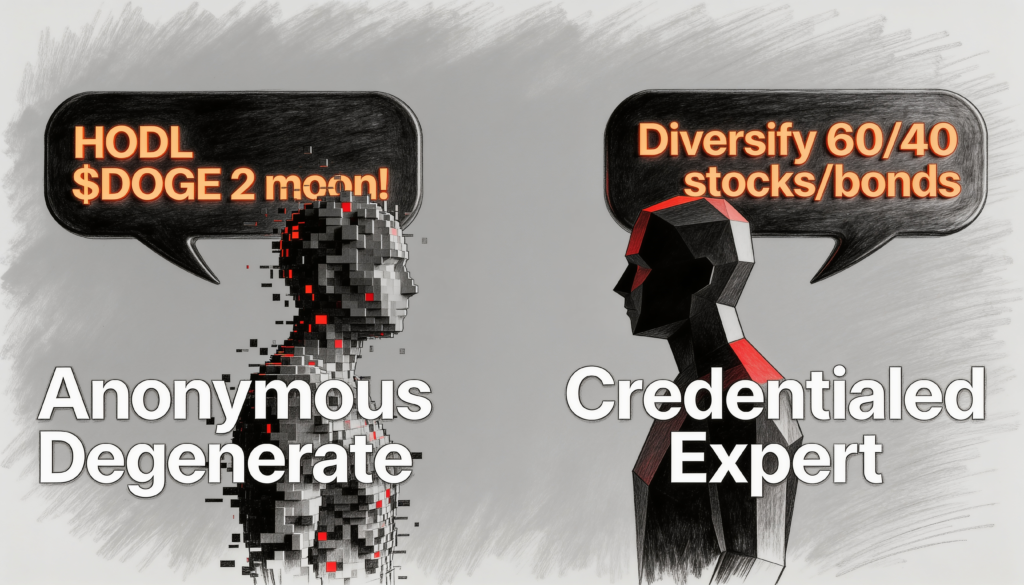
WallStreetBets and FinTwit sit on opposite ends of a question that most people in finance would rather not think about too carefully. Who deserves to be trusted with financial influence? The anonymous crowd that does not even pretend to know what it is doing? Or the verified expert class that very much pretends, and sometimes does, and sometimes does not? This is not really a debate about investing strategies. It is a debate about what trust actually means when money is involved.
The Credential Illusion: Why Expertise Does Not Equal Accuracy
FinTwit operates on a credibility economy. Names matter. Bios matter. The blue check used to matter before it became something you could buy for the price of a mediocre lunch. The implicit deal is simple. I show you who I am, what I have done, and where I have worked, and in exchange you take my market opinions seriously. This is a perfectly reasonable system. It is also a system with a serious flaw.
Credentials tell you what someone has survived. They do not tell you what they will get right next. A fund manager with twenty years of experience has twenty years of experience in markets that no longer exist in quite the same form. A CFA charter tells you someone passed three difficult exams. It does not tell you whether their current thesis on semiconductor stocks is correct.
FinTwit is full of genuinely brilliant people. It is also full of people whose expertise is real but whose public predictions are no better than a coin flip dressed up in sophisticated language. The credentials create a halo effect. Once you believe someone is an expert, you start interpreting their vague statements as profound and their wrong calls as unlucky rather than uninformed.
The coat is not the competence. But the coat sure does make the competence feel more real.
There is a parallel in medicine. Studies have shown that patients trust doctors who wear white coats more than doctors who do not, even when the advice is identical. The same psychology applies to finance. The suit, the verified badge, the impressive job title, all of these function as a white coat for money. They make competence feel real without proving it exists. This is the heart of why credentialed financial experts can be confidently wrong while looking authoritative the entire time.
When the Experts Were Spectacularly Wrong
The history of financial markets is littered with credentialed experts who were spectacularly, confidently, and expensively wrong. Long Term Capital Management was run by Nobel Prize winners. Their models were elegant, their pedigrees flawless, and their fund collapsed so violently that the Federal Reserve had to organize a rescue to prevent it from dragging down the broader financial system.
The 2008 financial crisis offered an even larger lesson. The institutions that packaged and rated subprime mortgage securities were staffed by some of the most credentialed people in the world. The rating agencies stamped toxic assets with the highest possible grades. The experts did not merely fail to see the danger. Many of them actively manufactured it while wearing the very credentials that were supposed to protect investors from such outcomes.
The Honesty of Chaos: What Anonymous Crowds Get Right
WallStreetBets is the opposite model. Nobody is pretending to be an expert. The culture is built on the open admission that most participants have no idea what they are doing. They call themselves degenerates. They celebrate losses as enthusiastically as gains. They post screenshots of portfolios that have gone to zero with the same energy that FinTwit posts screenshots of portfolios that are up.
This is usually dismissed as recklessness, and much of it genuinely is. But there is something buried in the chaos that deserves a closer look. When nobody claims authority, nobody can abuse it.
The traditional financial advice ecosystem is riddled with conflicts of interest that hide behind credentials. The analyst who upgrades a stock her firm is underwriting. The financial advisor whose recommendations happen to generate the highest commissions. The newsletter writer who buys before he publishes and sells into the demand he creates. These are not hypothetical scenarios.
WallStreetBets strips all of that away. There is no pretense of objectivity because there is no pretense of expertise. When someone on Reddit posts a trade thesis, you know exactly what you are getting. One person’s bet, presented without professional packaging. You are free to follow it or ignore it. The absence of authority is, paradoxically, a form of transparency.
The GameStop Case Study: When Retail Investors Outsmarted Wall Street
WallStreetBets produced some of the most spectacular financial disasters in retail investing history. People lost their life savings on options they did not understand. The gain posts are survivorship bias in its purest visual form. For every screenshot showing a fortune made, there are hundreds of accounts that quietly went to zero and never posted again.
But WallStreetBets also produced GameStop. And whatever you think about the long term merits of that trade, the mechanics of it revealed something that credentialed finance had been ignoring for years. It revealed that short interest could create vulnerability, that retail coordination was possible, and that the plumbing of the market was not as robust as the experts claimed.
A crowd of self described idiots identified a structural weakness that professionals with Bloomberg terminals had overlooked. Or worse, had seen and chosen to exploit from the other side.
This is the counterintuitive heart of the matter. The short interest in GameStop had exceeded one hundred percent of the available float, a mathematical absurdity that professional investors had treated as a routine bet rather than a structural fragility. It took an anonymous crowd, motivated by humor and stubbornness rather than fees, to notice that the emperor had no clothes. The retail investors did not have better credentials. They simply had no incentive to look away from what was plainly there.
The Trust Paradox: Both Sides Have Embarrassed Themselves
Here is where it gets interesting. Both communities have produced outcomes that should embarrass them, and both communities have produced outcomes that should impress their critics.
FinTwit has hosted some of the most predictive market calls of the past decade. People who identified inflation early, who warned about specific credit risks, who laid out detailed theses that played out almost exactly as described. This is real expertise, shared publicly, for free, and it does not get enough credit.
But FinTwit has also produced an entire industry of people who are primarily skilled at sounding smart about markets rather than being right about them. The format rewards articulation over accuracy. A well written thread explaining why a particular stock will collapse gets thousands of retweets whether the stock collapses or not. Six months later, nobody goes back to check. The timeline moves on, and the cost of being wrong evaporates.
WallStreetBets carries its own contradiction. The same crowd dynamics that created the GameStop squeeze also created pump and dump schemes that transferred money from late arrivals to early ones. Honesty about gambling does not make a game fair. The community celebrates transparency while remaining deeply vulnerable to manipulation, precisely because everyone has agreed not to take anything seriously.
The Real Divide Is Not Expertise. It Is Incentives.
When you strip away the cultural differences, the memes, the jargon, and the aesthetics, WallStreetBets and FinTwit are really arguing about something much deeper than trading strategy. They are arguing about who gets to be trusted in a system where trust itself has been monetized.
FinTwit monetizes trust through reputation. Build a following, demonstrate insight, and eventually convert that attention into a newsletter, a fund, a consulting gig, or a media career. The incentive is to appear consistently intelligent. Not necessarily to be consistently right, but to always look like you could be.
WallStreetBets monetizes trust differently, or rather it does not monetize trust at all. It monetizes entertainment. The culture does not reward being right. It rewards being interesting. The person who posts a wildly reckless trade and narrates the outcome, up or down, with humor and self awareness, gets more engagement than someone who quietly makes sensible returns.
This means FinTwit has a credibility problem disguised as expertise, and WallStreetBets has an expertise problem disguised as honesty. Neither system actually solves the fundamental issue, which is that in finance, the people most motivated to give you advice are usually the people who benefit most from you taking it.
Follow the Incentive, Not the Credential
The deeper truth is that financial trust was never really about credentials or anonymity. It was about the alignment of interests. Do the people giving you information benefit when you succeed, or do they benefit when you simply act? Those are two very different things.
A financial advisor who earns a fee regardless of your returns benefits when you act. A Reddit poster who shares a trade they have already entered benefits when you act. A FinTwit personality who sells a course benefits when you act. In all three cases the advice might be perfectly good. But the incentive is not attached to whether it works. It is attached to whether you follow it.
The person most worth trusting in finance is probably the one who is not trying to convince you to trust them.
This is why the question of credentialed expert versus anonymous degenerate is the wrong frame entirely. A licensed advisor with a conflict of interest and an anonymous poster talking up a bag they want to dump are functionally identical. Both want your action more than they want your success. The credential changes the costume, not the incentive.
What Both Sides Consistently Miss
FinTwit tends to overestimate how much credentials protect you from being wrong. The collapse of Long Term Capital Management and the failure of countless celebrated fund managers prove that intelligence and pedigree offer no immunity from catastrophe. Markets do not check your resume before they take your money.
WallStreetBets tends to overestimate how much transparency protects you from being manipulated. Just because someone admits they are gambling does not mean the game is fair. The same coordination that humbled hedge funds can be weaponized against the very people who feel safest inside the crowd. Admitting your own ignorance does not make you immune to someone else’s deception.
There is a third group that both communities ignore, and it deserves mention. The traditional financial industry, the world of brokerages, advisory firms, and product manufacturers, depends entirely on the belief that someone else knows more than you do. Their business model requires that belief. This makes the truly disinterested expert rarest of all inside the very institutions that claim to embody expertise.
The Real Lesson: Understanding Beats Trust Every Time
The most useful thing about watching WallStreetBets and FinTwit coexist is not figuring out which one is right. It is recognizing that trust in finance has always been a performance. Sometimes a polished, credentialed, well spoken performance. Sometimes a chaotic, anonymous, self deprecating performance. But always a performance.
The credential does not guarantee the insight. The anonymity does not guarantee the honesty. And the follower count guarantees absolutely nothing. The person worth listening to is the one who shows their work, admits what they do not know, and does not benefit from whether you agree with them. That person is very rare on FinTwit. They are even rarer on WallStreetBets. And they are the rarest of all in the traditional financial industry.
A Practical Filter for Internet Financial Advice
So how should you actually evaluate financial advice online, regardless of whether it comes from a credentialed expert or an anonymous account? A few questions cut through almost all of the noise:
- Does the person profit if you act, regardless of whether the advice works? If yes, weigh everything they say accordingly.
- Do they show their reasoning, or only their conclusion? A thesis you can examine is worth more than a confident verdict you must accept.
- Do they revisit their wrong calls? Anyone who only highlights their wins is curating, not informing.
- Are they comfortable saying they do not know? Genuine analysis lives in uncertainty. Salesmanship lives in certainty.
- Does the advice depend on urgency? Real opportunities rarely require you to act before you understand.
Notice that none of these filters ask about credentials, and none of them ask about anonymity. They ask about incentives, transparency, and intellectual honesty. Those are the variables that actually predict whether information will help you. A credential is a weak proxy for them. Anonymity is no proxy at all.
Maybe the real insight is not that anonymous crowds are trustworthy or that credentialed experts are reliable. Maybe it is that trust itself is the wrong framework for financial decisions. Understanding is a better one. And understanding, unfortunately, does not come from following anyone. It comes from doing the work yourself, which is the single thing neither community is particularly good at encouraging.
The a young man who moved a stock more than a hedge fund manager was not smarter than the experts. The experts who missed it were not stupid. The difference was never about intelligence or credentials. It was about who was paying attention to reality and who was paying attention to the performance.
In the end, the best financial advice on the internet does not come from the loudest voice, the most verified badge, or the funniest meme. It comes from learning enough to no longer need anyone’s advice at all.