Table of Contents
There is a particular kind of silence in financial markets that should worry you more than the noise. It is the silence of a trade so old, so deeply woven into the plumbing of global finance, that nobody really thinks about it anymore. The yen carry trade is that silence. And right now, two central banks are staring at each other across the Pacific, each waiting for the other to flinch.
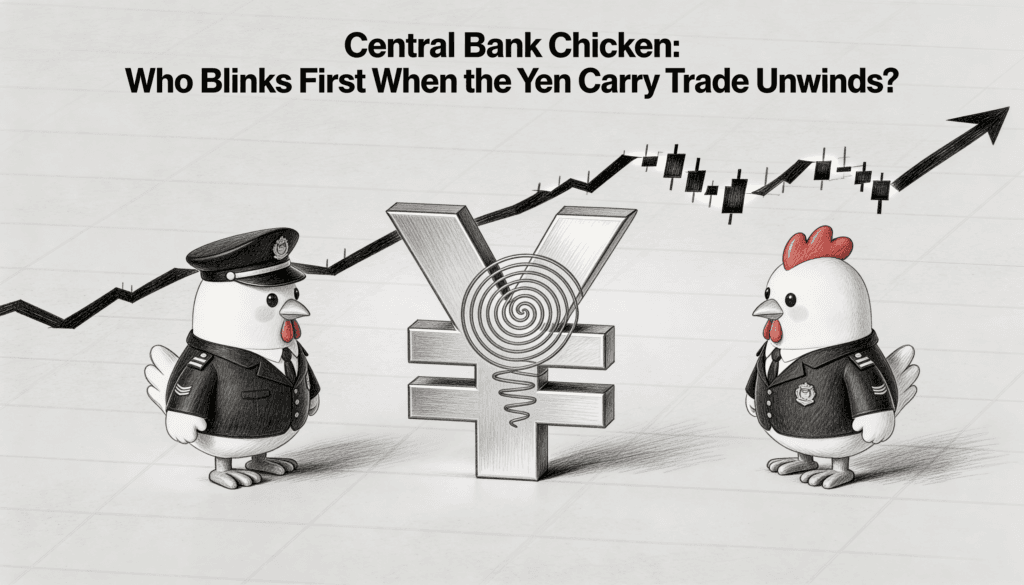
This is not a story about Japan. It is a story about coordination problems, the limits of central bank theater, and what happens when the cheapest source of money in the world stops being cheap. It is, in the most literal sense, a game of chicken. The Bank of Japan has its foot on the accelerator. The Federal Reserve has its foot on the brake. Both of them know that whoever turns the wheel first determines who gets blamed for the crash.
Let me explain why this is more interesting than it sounds.
The Trade That Built A Generation Of Returns
For roughly three decades, Japan exported something more valuable than cars or electronics. It exported cheap money. A hedge fund in London or a pension manager in Sydney could borrow yen at nearly zero percent and use that money to buy almost anything that paid more, which was almost everything. Brazilian bonds. Australian property. American tech stocks. Indian equities. Bitcoin, eventually. The yen was the world’s funding currency, and the world barely noticed.
This was not a strategy so much as a gravitational field. When borrowing costs you nothing and the asset you buy yields four, five, six percent, you have built a money machine. The only catch is that the yen must stay weak, or at least stable. If the yen rises sharply against the dollar, your cheap loan suddenly is not cheap, because you have to pay it back in a more expensive currency. Your profit margin evaporates. Then it goes negative. Then you panic.
Now consider what has changed. The Bank of Japan has lifted its policy rate to 0.75 percent. That number sounds laughable next to the Fed’s 3.5 to 3.75 percent. But the direction matters more than the level. Japan is hiking while the rest of the world is cutting. The spread that fueled the trade is narrowing from both ends. And Japanese ten-year bond yields recently touched 2.8 percent, a level not seen since 1997, which is roughly when most of today’s portfolio managers were learning to ride bikes.
The Game Theory Nobody Talks About
Here is the angle that financial commentary tends to miss. Central banks are usually analyzed as if they were sober technocrats responding to data. They are not. They are players in a game where their main opponents are other central banks, and where the worst outcome for everyone is the one nobody can prevent on their own.
The Bank of Japan needs to normalize rates. It has wanted to for years. Japanese savers have been punished for a generation by zero interest rates. Inflation has finally arrived, and the yen has been embarrassingly weak. Domestically, the case for hiking is overwhelming. Internationally, the case for hiking is terrifying. Because if the BOJ moves too fast, it unwinds the carry trade, repatriates Japanese capital, and triggers a global selloff that lands at its own doorstep within weeks.
The Federal Reserve, meanwhile, would like to keep cutting. The American economy is slowing in patches. But cutting too aggressively narrows the spread further, which gives Japanese investors even more reason to bring their money home. The Fed cannot easily ease without making the BOJ’s job harder. The BOJ cannot easily hike without making the Fed’s job harder.
This is the classic structure of a chicken game. Each player has a strong individual incentive to act. Each player knows that if both act, the result is bad for everyone. So both players move slowly, send mixed signals, and try to look unpredictable enough that the other side flinches first. The currency markets, watching this with the patience of a cat watching a moth, price every word.
What is genuinely strange is that the worst outcome is not aggression. It is misreading the other side. If the BOJ hikes more than the Fed expects, or the Fed cuts more than the BOJ expects, the spread closes faster than positions can be unwound. That is the July 2024 scenario, when a single BOJ rate move triggered a cascade. Nobody wanted that. It happened anyway.
The Hidden Layer: Why Capital Repatriation Is The Real Story
Most commentary on the carry trade focuses on hedge funds. This is misleading. The hedge fund piece is the loud part of the iceberg. The quiet part, which is much larger, is Japanese institutional capital that has been parked abroad for decades because there was nothing to do with it at home.
Japanese pension funds, life insurers, and banks collectively hold trillions of dollars in foreign assets. They bought US Treasuries because Japanese government bonds paid nothing. They bought European corporate debt because Japanese corporate debt paid nothing. They bought American stocks because Japanese growth was anemic. None of this was speculative. It was the natural behavior of patient money searching for any yield at all.
When Japanese ten-year bonds suddenly pay 2.8 percent, this calculus inverts. For the first time since the Clinton administration, a Japanese life insurer can meet its return obligations without leaving Tokyo. Without currency risk. Without political risk. Without the embarrassment of explaining to regulators why so much of the balance sheet is denominated in dollars. Japan sold roughly 30 billion dollars in US Treasuries in just the first quarter of this year. That is not a hedge fund unwinding a position. That is a civilization quietly bringing its savings home.
This is the part that makes the chicken game so unstable. Hedge funds can be talked down. They read central bank statements. They watch press conferences. They adjust positions based on guidance. Japanese institutional investors do not particularly care what Jerome Powell says at his next briefing. They care about the yield on a Japanese government bond, which is now real and rising. The repatriation flow is mechanical, not emotional. And mechanical flows are the hardest to stop once they start.
What The Game Looks Like From The Inside
If you are sitting at the BOJ right now, you have a problem that economics textbooks do not really cover. You need to raise rates because your domestic situation demands it. But you cannot raise them too quickly because you are responsible, at least partially, for the stability of global financial markets that depend on your cheap money. Every quarter point matters. Every word in your statement matters. You have to communicate firmness without panic, gradualism without weakness, independence without arrogance.
If you are sitting at the Fed, your problem is different but related. You would like to ease policy to support American growth. But every cut you make tightens the squeeze on the carry trade by closing the spread. You are aware that your easing could become the trigger for someone else’s crisis, and that crisis would eventually come back to you in the form of repatriated capital and falling Treasury prices. You cannot say this out loud, because central banks do not openly coordinate. You can only hint, signal, and hope.
Both sides are playing a game where the optimal individual move depends entirely on what the other side does, and neither side can fully trust the other’s communication. This is exactly the situation game theorists call a coordination failure. The solution requires either trust, which central banks do not really have with each other in public, or a clear focal point that both sides can converge on. There is no obvious focal point here.
The Counterintuitive Possibility
Here is a thought worth holding. The carry trade unwind might not be a single event. It might be a slow leak that nobody can pinpoint, because everyone is watching for the dramatic moment that never comes. Markets are very good at digesting bad news that arrives in a flash. They are surprisingly bad at digesting bad news that arrives as a gentle, persistent drift over many months.
If Japanese institutions sell US Treasuries at a steady pace for two years, you will not see a crash. You will see a slow rise in US bond yields, a slow weakening of the dollar, a slow underperformance of long duration assets, and a slow rotation away from the trades that defined the last decade. By the time everyone agrees the unwind happened, it will have already happened. There will be no satisfying climax, no clean narrative, just a quiet repricing without giving an obvious villain to blame.
What Actually Matters For Anyone Watching
The temptation when reading about all this is to ask what trade to put on. That is the wrong question. The right question is what assumptions in your existing portfolio quietly depend on the yen carry trade continuing in roughly its current form. Long duration bonds assume it. Growth stocks at elevated valuations assume it. Most emerging market positions assume it. The whole structure of leveraged carry across global markets assumes it.
You do not need to predict the timing of the unwind to take it seriously. You only need to recognize that an assumption you did not know you were making has become more fragile. The investors who survive these transitions are not the ones who time them perfectly. They are the ones who notice the assumption before they have to find out about it from a margin call.
The chicken game continues. Neither side has blinked. But the game has a feature that real chicken does not. In real chicken, when one driver swerves, the other one wins. In central bank chicken, when one of them swerves, both cars hit the wall anyway. The only question is who gets to write the press release explaining why it was not their fault.
That press release is being drafted right now. We just do not know which central bank will publish it first.