Table of Contents
There is a quiet little number that decides whether a company is actually building wealth or merely pretending to. It does not appear on the front page of annual reports. It is not what CEOs brag about on earnings calls. It does not trend on financial television. Yet it is, arguably, the single most honest verdict you can deliver on a business.
It is the spread between ROIC and WACC.
Return on invested capital minus the weighted average cost of capital. Two acronyms that sound like they belong in a tax accountant’s nightmare, and yet together they form the closest thing finance has to a lie detector. Every other metric a business shows you can be dressed up, restated, adjusted, smoothed, or buried in a footnote. This one cannot. Either the company earns more on the money it uses than that money costs, or it does not.
And once you start seeing businesses through this lens, you cannot unsee it. Suddenly the world of investing looks less like a casino and more like a slow, patient sorting machine that separates the genuine wealth creators from the impressive looking value destroyers. The catch is that the sorting takes years, sometimes decades, which is exactly why so few people bother to look.
The Most Underrated Idea in Business
Let us start with a thought experiment. Imagine you borrow money at six percent and invest it in a business that earns four percent. You are losing two percent on every dollar, forever. The more you borrow, the more you grow, the poorer you become. Growth, in this scenario, is not a virtue. It is a slow motion accident.
Now reverse it. You borrow at six percent and invest it in something that earns sixteen percent. Every dollar you can scrape together becomes a wealth generating machine. Growth here is not just good, it is the entire point. The bigger you get, the richer you become.
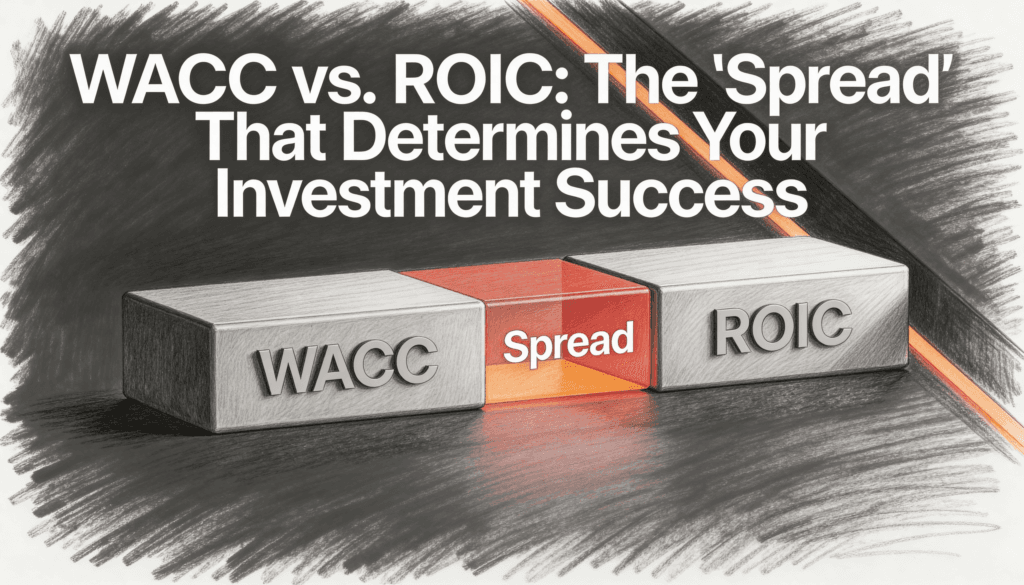
This is the whole game. ROIC is what the business earns on the capital it has put to work. WACC is what that capital costs, blended across debt and equity. The difference between the two, what professionals call the spread, is the actual rate at which a business creates or destroys value in the world.
If a company has a fifteen percent ROIC and a nine percent WACC, it is earning a six percent spread on every dollar invested. Compound that across billions of dollars and decades of operations, and you understand why some businesses become legends while others become cautionary tales. They are not playing different sports. They are playing the same sport with wildly different scores.
What is strange is how rarely investors talk about this. They will spend hours debating quarterly earnings, dissecting guidance, parsing the tone of a CFO’s voice for hidden meanings. Meanwhile, the spread sits there in plain view, doing the only work that actually matters over the long run. It is the financial equivalent of someone ignoring the foundation of a house to argue about the curtains.
Why Most CEOs Quietly Hate This Metric
Here is something that does not get said out loud often enough. Most corporate executives have no real incentive to maximize the spread between ROIC and WACC. Their compensation is usually tied to revenue growth, earnings per share, stock price, or some combination of metrics that can be juiced in ways that do not require actually earning more than your cost of capital.
You can buy growth. You can borrow cheaply, acquire competitors at any price, expand into markets where you have no advantage, and watch your top line balloon impressively. The board will applaud. The press will write profiles. Your bonus will arrive on time. And somewhere in the background, your spread will be quietly shrinking, your business will be quietly destroying value, and only the patient observer with a calculator will notice.
This is one of the great open secrets of modern capitalism. A huge portion of corporate activity, including most large acquisitions, exists not because it creates value but because it creates the appearance of momentum. Momentum is rewarded. Value creation, the boring quiet kind that comes from doing the same thing well year after year, often is not.
The investors who understand this start to develop a kind of immunity to corporate noise. They stop being impressed by big announcements. They stop caring about whether the CEO is charismatic. They start asking one question over and over again. Is this company earning more on its capital than it costs to obtain that capital, and is the gap getting wider or narrower?
It is a deeply unsexy question. It is also the question that explains almost every great long term investment outcome and almost every great long term failure.
The Beauty of Boring Businesses
There is a kind of poetry in discovering that the most valuable businesses in the world are often the ones nobody wants to talk about at dinner parties. They sell products like industrial coatings, payment processing services, niche software for accountants, specialty chemicals, or food ingredients. They are not glamorous. They are not changing the world. They are simply, relentlessly, earning twenty or thirty percent on their invested capital while their cost of capital sits in the high single digits.
That spread, compounded over decades, builds empires. Quiet ones, but empires nonetheless.
Compare this with the more exciting kind of business. The one that announces a new product every quarter, raises money at ever higher valuations, and burns cash with the confidence of a teenager on their first credit card. These businesses can have very low or even negative ROIC for years. They are subsidized by capital markets that have decided, often for reasons that have more to do with narrative than arithmetic, that the spread will eventually arrive.
Sometimes it does. Sometimes it does not. And when it does not, the bill comes due in a way that is both predictable and brutal. The interesting paradox is that the boring business with the high spread was always the better bet, mathematically speaking. It is just that mathematics is not what drives most investing decisions on a day to day basis. Stories are.
The Three Levers, and Why Only One of Them Matters
If you want to widen the spread, you really only have three options. You can earn more on your existing capital, which means improving margins or asset turnover. You can lower your cost of capital, which usually means becoming a safer borrower or earning the trust of equity investors who will accept lower returns. Or you can stop deploying capital into projects that earn less than they cost, which sounds obvious but is psychologically almost impossible for most management teams.
The third lever is the one almost no one pulls. It requires admitting that some part of your business is not worth the capital it consumes. It requires shrinking. It requires firing the part of yourself that wants to be bigger next year than this year. And it requires the kind of executive temperament that is, for reasons of natural selection in corporate environments, exceptionally rare.
The CEOs who do pull this lever are often considered strange. They sell off divisions instead of buying them. They return cash to shareholders instead of finding new things to spend it on. They sometimes shrink their companies for years before growing them again. The market often punishes them in the short run for this discipline, then rewards them spectacularly in the long run when the spread reasserts itself.
What the Spread Quietly Tells You About the World
Once you start thinking in terms of the spread, certain patterns in the world become hard to ignore. You start to notice that industries with structurally low spreads, like airlines or restaurants or commodity manufacturing, are full of companies that have been working very hard for very long with very little to show for it. The capital flows in, the capital flows out, and the cumulative result is roughly nothing. Generations of effort, transferred almost entirely to customers in the form of lower prices, and to suppliers in the form of higher costs.
Meanwhile, industries with structurally high spreads, like certain kinds of software, specialty pharmaceuticals, branded consumer products, and exchanges, quietly mint wealth year after year without anyone making much of a fuss about it. The work being done in these industries is not necessarily harder or smarter than the work being done in low spread industries. It is just better positioned in the value chain. The spread is, in many ways, a measure of where you sit in the food chain of an economy.
This raises an uncomfortable question that most investors never quite confront. Are you investing in businesses because they are doing impressive things, or because they sit in places where impressive things turn into actual returns? These are not the same question. A mediocre business in a great position will often outperform a brilliant business in a terrible one. The spread does not care about effort. It cares about positioning.
The Patience Tax
There is one final thing worth saying about all of this. The spread between ROIC and WACC, in my opinion, is the most useful concept in investing, and it is also the most ignored, and the reason for the ignoring is simple. It takes time to work.
In any given quarter, in any given year, even sometimes over three or five years, a company with a terrible spread can outperform a company with a wonderful one. Capital markets are emotional. Narratives drive prices. Mood matters. The spread is a glacier. It moves slowly, but when it moves, it carves valleys.
This is why so few investors actually use it. Not because the concept is hard. Anyone can understand it in about ten minutes. But because it asks you to hold positions through periods where the metric you care about is not the metric the market cares about, and that is psychologically exhausting in a way that is almost impossible to convey to someone who has not lived through it.
The investors who do hold on, who keep their eyes on the spread while everyone else is watching the price, are not smarter than the rest. They are just stubborn in a particular way. They have decided that mathematics will, eventually, win. And they are usually right, eventually being the operative word.
A Closing Thought
In a world drowning in financial information, where every company can produce a beautiful slide deck explaining why it deserves your capital, the spread between ROIC and WACC stands out for a single reason. It cannot be faked for very long.
A company can lie about almost anything else. It can manage its earnings, time its disclosures, hire impressive consultants, write inspiring mission statements, and put together quarterly presentations that look like art. But it cannot, year after year, claim to be creating value while earning less on its capital than that capital costs. The arithmetic catches up. The market eventually notices. The spread, like gravity, just keeps doing its work whether anyone is paying attention or not.
If you take one habit away from any conversation about investing, let it be this. Before you fall in love with a story, check the spread. Before you trust a CEO, check the spread. Before you assume that growth is good, check the spread. It will not tell you everything. But it will tell you the one thing that nothing else can. Whether the business in front of you is making the world wealthier, or just busier.
And that, in the end, is the only distinction that matters.