Table of Contents
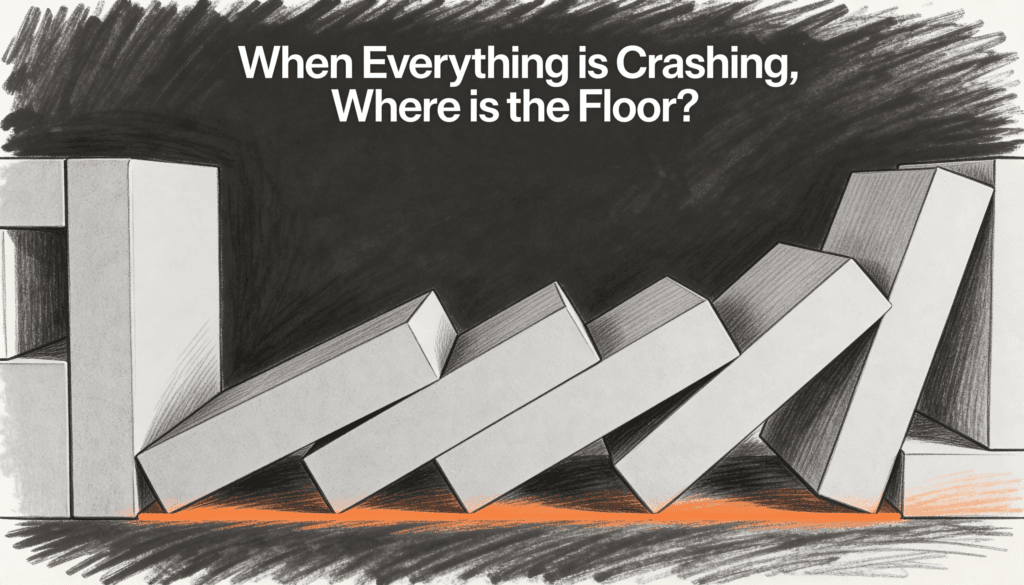
There is a peculiar moment during every market crash when serious people on television start using the word “unprecedented” with the same frequency that teenagers use “literally.” Charts turn red. Anchors lower their voices as if attending a funeral. Someone, somewhere, inevitably brings up 1929, then 2008, then mutters something about the Dutch tulip mania for good measure. And the question hanging over all of it, the one nobody can answer but everyone keeps asking, is the same question a child asks when jumping into a dark lake.
How deep does this go?
The honest answer is that nobody knows. The more interesting answer is that the question itself is wrong. Because the floor is not a place. It is a feeling. And feelings, as anyone who has ever been in love or in debt can tell you, are not exactly known for their precision.
The Floor That Is Not There
We tend to think of the stock market the way we think of a building. There is a ceiling, there is a floor, and if things get really bad, there is a basement. This metaphor is comforting because buildings are made of concrete and steel, which are reassuringly solid materials that do not vanish when people get scared.
The market is not made of concrete and steel. The market is made of opinions. Every price you see on a screen is just two strangers agreeing, for one fleeting second, on what something is worth. Multiply that by millions of strangers, add caffeine, fear, ambition, and a great deal of borrowed money, and you have what economists call a market and what philosophers might more accurately call a mood.
This is why the floor keeps moving. It is not a structural feature. It is a temporary truce between people who want to sell and people who want to buy. When the buyers all decide, at roughly the same moment, that they would rather hold cash and watch from the sidelines, the floor simply dissolves. Not because anything fundamental changed in the world overnight, but because the agreement evaporated.
The Tyranny of Reference Points
Here is a strange experiment. Imagine you bought a stock at 100 dollars. It goes up to 150. You feel rich. Then it falls back to 100. You feel like you have lost money. But you have not. You are exactly where you started. The 50 dollars was never really yours. It was a number on a screen, briefly attached to your name, that you mistook for wealth.
This is what behavioral economists call anchoring, and it is the reason crashes feel so much worse than they actually are. We do not measure our losses against reality. We measure them against the highest point we remember. The peak becomes the baseline, and everything below it feels like injury rather than the natural breathing of a system that was always going to breathe.
If you bought Amazon in 2000, you watched it lose more than eighty percent of its value over the next two years. eighty percent. The kind of number that makes people stop opening their brokerage statements and start opening their wine bottles. And yet, if you had held on, you would now be sitting on one of the great fortunes of the modern age.
The floor was not where it appeared to be. It was much lower than anyone expected, and then much higher than anyone could have imagined. The investors who survived were not the ones with the best floor estimates. They were the ones who stopped looking for floors entirely and started looking at something else.
What the Old Money Knows
There is a particular kind of wealth that does not panic during crashes. You can spot it because it does not exist on Twitter, does not appear on financial news, and rarely says anything interesting at dinner parties. It is the money that has been around long enough to have seen this before. Several times. Possibly during a war or two.
Old money has a relationship with time that new money simply cannot fake. When you have inherited assets that survived the Great Depression, two world wars, the oil shocks, the dot com bust, and the financial crisis, you start to develop a certain attitude toward red days. The attitude is roughly that of a Scottish farmer looking at a heavy rain. It is uncomfortable, yes. It is also Tuesday.
The Rothschilds reportedly told their bankers to buy when there is blood in the streets. This is excellent advice that nobody can follow, because when there is actually blood in the streets, the people with money are typically too busy worrying about their own pulse to think about bargains. The wisdom is correct. The execution requires a temperament that most of us do not possess and cannot acquire by reading about it.
What the old money knows is that the floor is not a price. The floor is your ability to wait. If you can hold an asset for thirty years, almost any entry point looks reasonable in retrospect. If you have to sell in thirty days, almost no entry point is safe. The floor moves depending on how long you can afford to ignore it.
The Stoic in the Storm
The Roman emperor Marcus Aurelius, who had quite a lot on his plate including barbarians and plague, wrote a private journal about how to maintain composure when everything is going wrong. He never traded stocks, but his observations apply with eerie precision to bear markets.
He noticed that most of our suffering comes not from events themselves but from our judgments about events. The crash is not the problem. Our story about the crash is the problem. The same red number on a screen can produce panic in one person and patience in another, depending entirely on what that number means to them.
The Stoic move is to ask what is actually in your control. The price of your portfolio is not. The macroeconomic environment is not. The decisions of central bankers, the moods of foreign governments, the velocity of money, none of these are things you can influence. What you can influence is your behavior in response to all of it. Whether you sell at the bottom because you cannot stand the pain anymore. Whether you panic into cash and then watch from the sidelines as everything recovers without you. Whether you turn a temporary paper loss into a permanent realized one through the simple act of clicking sell.
The Floor Is Made of Liquidity
There is a less philosophical and more mechanical answer to the question of where the floor is, and it has to do with something called liquidity. Liquidity is the financial term for the existence of someone willing to buy what you want to sell. When liquidity is abundant, the floor is high and stable. When liquidity dries up, the floor falls through itself, because there is literally nobody on the other side of your trade.
This is the dark secret of modern markets. They function beautifully when everyone is calm and terribly when everyone is scared, which is precisely the opposite of what you would want from a system that exists to allocate capital. It is as if your umbrella worked perfectly except during rain.
The crashes that become legends are almost always liquidity events. Not because the underlying companies became worthless overnight, but because the machinery of trading temporarily seized up. The buyers stepped back. The sellers piled in. The price fell faster than anyone could rationally justify, and then it kept falling, because falling prices create more sellers, who create more falling prices, in a spiral that has nothing to do with value and everything to do with the architecture of fear.
The floor, in this sense, arrives when the last forced seller has sold. Not the patient seller, not the strategic seller, but the seller who had no choice. Margin calls, redemptions, retirement deadlines, divorce settlements. When that wave passes, when the people who had to sell have finished selling, the floor reveals itself. It is rarely where anyone expected it to be.
A Different Question
So maybe the question is not where the floor is but why we want to know.
If you are asking because you are afraid, the answer will not help you. Even if someone could tell you the exact bottom, you would not believe them, because nobody believes a forecast that contradicts their fear. We do not seek information when we are scared. We seek reassurance, which is a different thing entirely, and which markets are notoriously bad at providing.
If you are asking because you want to buy, you are asking the wrong question. The right question is not where the floor is but what you want to own for the next decade. The floor is a tactical concern. Ownership is a strategic one. The people who get rich in crashes are not the ones who time the bottom. They are the ones who know what they would happily own at any price below a certain level and then have the discipline to actually buy when prices reach there.
If you are asking because you want to sell, you have already missed the moment. The time to think about selling was when everyone was euphoric and prices made no sense on the upside. The time to ask about floors is the time to ask about your own willingness to keep holding.
What Remains When the Numbers Move
There is a quiet truth that emerges from every market downturn, and it is rarely discussed because it is too simple to make for good television. The truth is that most of life is unaffected by what the market does on any given day. The bread you eat tastes the same. The conversations you have with people you love continue. The sun, indifferent to the financial press, rises and sets on schedule.
This is not meant to minimize the real pain that crashes inflict on real people, especially those nearing retirement or already in it. Those concerns are valid and serious and deserve more attention than they typically receive. But for the much larger group of investors who have time on their side, the crash is mostly a story they are telling themselves about a series of numbers that will probably look very different in five years.
The floor, in the deepest sense, is not in the market at all. It is in you. It is your capacity to keep going when the screen turns red, your ability to remember what you were trying to build in the first place, your willingness to be unimpressed by both the highs and the lows.
The market does not have a floor. It has gravity, it has cycles, it has fear and greed in alternating doses. But the foundation on which any sane investing life is built is not made of prices. It is made of patience. And patience, unlike floor estimates, never quite goes out of style.
When everything is crashing, the most useful question is not where the floor is. The most useful question is whether you can be the kind of person who does not need to know.