Table of Contents
Most people remember Henry VIII for his wives. Six of them, two beheaded, a track record that makes modern dating look remarkably civil. But his most lasting damage was not to his marriages. It was to money itself.
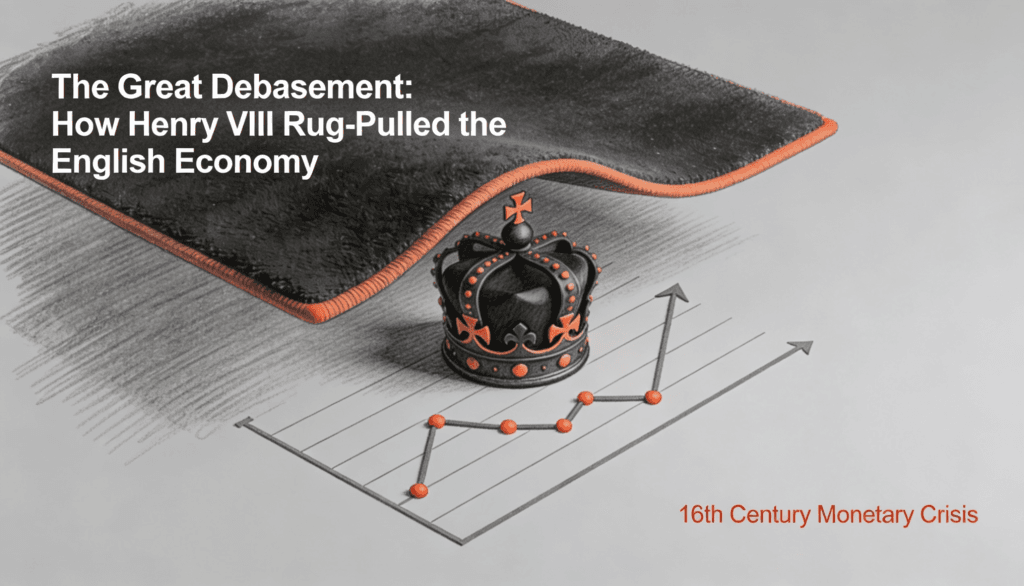
Between 1544 and 1551, Henry VIII and his son Edward VI systematically stripped the silver out of English coinage, replacing it with cheaper base metals. Historians call this the Great Debasement. In modern terms, it was a slow motion rug pull on an entire nation. The king looked his people in the eye, handed them coins that said one thing, and made sure they were worth something else entirely.
What makes this story worth telling is not just the history. It is what it reveals about money, trust, and the quiet violence that governments can do to an economy without ever raising a sword.
Money before money made sense
To understand why the Great Debasement mattered, you have to understand what money actually was in the 1500s. There were no central banks. No monetary policy committees. No one was publishing inflation forecasts. Money was not an abstraction backed by institutional credibility. It was a physical object, and its value came from what it was literally made of.
A silver coin was worth something because it contained silver. That was the deal. The king’s face stamped on the front was not really a guarantee of value. It was a guarantee of weight and purity. When you accepted a shilling, you were not trusting the government. You were trusting the metal.
This made pre-industrial money surprisingly honest in one way and dangerously fragile in another. Honest because the value was baked into the object itself. Fragile because anyone with access to the mint could quietly change the recipe.
The mechanics of a royal scam
Henry VIII needed money. This is not unusual for a king, but Henry needed it more than most. He had wars to fight in France and Scotland, palaces to maintain, and the kind of lifestyle that made fiscal discipline a non-starter. Taxation was politically difficult. Borrowing had limits. So he turned to the one funding source that required no permission from Parliament: the coinage itself.
The method was straightforward. You take coins that are supposed to be 92.5% silver and you start minting them at 50%. Then 33%. Then, under Edward VI, as low as 25%. The coins look the same. They have the same face value. But they contain a fraction of the precious metal they once did. The difference between what the silver cost and what the coins were nominally worth went straight into the royal treasury.
It was, in essence, a hidden tax. The most elegant kind, because most people did not even realize they were paying it.
The people who noticed
But people are not stupid, at least not forever. Merchants figured it out quickly. Foreign traders figured it out even faster. The problem with debased coinage is that it works exactly once as a surprise. After that, markets adjust.
English coins began trading at a discount on the continent. The exchange rate collapsed. A coin that said it was worth a shilling was treated like it was worth half that by anyone who bothered to scratch the surface. And people did scratch the surface. Literally. The copper underneath Henry’s portrait would show through on the nose first, earning him the nickname “Old Coppernose.” The king’s vanity, stamped in metal, became the very thing that exposed his fraud.
Prices rose. Not because there was suddenly less grain or wool, but because sellers demanded more coins for the same goods. They understood, even without the vocabulary of economics, that each coin was carrying less real value than before. This is inflation in its purest and oldest form. Not too much money chasing too few goods, but the same amount of goods refusing to accept money that had been hollowed out from the inside.
Gresham’s Law before Gresham
Here is where it gets interesting from an investing perspective. The Great Debasement produced one of the most reliable patterns in monetary history, one that Thomas Gresham would later describe to Queen Elizabeth I: bad money drives out good.
When people realized that the new coins contained less silver than the old ones, they did the rational thing. They hoarded the old coins and spent the new ones. Why hand over a full silver shilling when a debased one with the same face value would do? The good money vanished from circulation. It was melted down, saved, or sent abroad where it could be valued properly. What remained in the economy was the worst coinage, the stuff nobody wanted to hold for a second longer than necessary.
This is not just a historical curiosity. It is a principle that shows up everywhere. In any system where two assets are supposed to be equivalent but one is clearly inferior, people will dump the inferior one and cling to the real thing. Think about that the next time you see a stablecoin that is technically pegged one to one but everyone seems suspiciously eager to trade out of.
The trust problem
The deeper lesson here is about trust, and how expensive it is to rebuild once it has been broken.
Pre-industrial money worked because people believed in the metal. The king’s stamp was just a convenience, a shorthand that saved you from weighing and assaying every coin. But when the stamp became a lie, people had to go back to first principles. They weighed coins. They tested them. They discounted them. Every transaction became slower, more suspicious, more expensive.
This is the hidden cost of debasement that never shows up in the royal accounts. The economy did not just suffer from inflation. It suffered from friction. Trust is a lubricant, and Henry removed it. Trade slowed not because people did not want to buy and sell, but because the basic unit of exchange had become unreliable. Every deal required a negotiation that previously did not need to happen.
There is a parallel here to modern financial crises. When Lehman Brothers collapsed in 2008, the immediate problem was not that banks ran out of money. It was that banks stopped trusting each other. The interbank lending market froze. Not because capital disappeared, but because no one could be sure what the assets on the other side were actually worth. Henry VIII would have understood the dynamic perfectly, even if he would not have cared.
The correction
The mess took years to clean out. Elizabeth I, Henry’s daughter, eventually restored the coinage in 1560. She called in the debased coins, melted them down, and reissued proper silver currency. It was enormously expensive. It was also one of the smartest economic decisions of the Tudor era.
What Elizabeth understood, and what her father did not, was that the short term profit from debasement was dwarfed by the long term cost. A functioning economy needs money that people do not have to think twice about. The moment your currency requires an asterisk, you have already lost something that money cannot buy back.
Prices stabilized. The exchange rate recovered. Trade resumed on normal terms. The speed of the recovery tells you something important: the underlying economy was not broken. The productive capacity of England had not changed. What had changed was the measuring stick, and once you fix the ruler, everything it measures snaps back into place.
What this means for modern investors
You might be wondering why any of this matters if you are not a Tudor merchant. It matters because the playbook has not changed.
Governments still face the same temptation Henry faced. When spending exceeds revenue and borrowing becomes uncomfortable, the currency itself becomes a funding source. Modern debasement does not involve mixing copper into silver. It involves expanding the money supply, holding interest rates below inflation, or running deficits that everyone knows will eventually be monetized. The mechanics are more sophisticated. The principle is identical. You are quietly transferring wealth from the people who hold the currency to the people who issue it.
The Great Debasement also illustrates something that investors tend to learn the hard way: nominal values are a distraction. Henry’s coins still said “one shilling” on them. They just were not worth a shilling anymore. In the same way, a portfolio can show a positive nominal return while losing purchasing power every year. The number on the screen goes up. What it can buy goes down. Henry VIII would have called that a successful monetary policy.
The counterintuitive takeaway
Here is the part that might surprise you. The Great Debasement, for all its damage, was not irrational from Henry’s perspective. It worked. He funded his wars. He maintained his court. He died in his bed, which is more than can be said for some of his wives. The costs were real but they were distributed across the entire population, diluted enough that no single person bore enough pain to revolt over it.
This is the dark genius of currency debasement. It is a tax that does not feel like a tax. It does not show up on a bill. It does not require enforcement. It just quietly makes everything a little more expensive, and by the time people understand what happened, the money has already been spent.
The lesson is not that debasement is always catastrophic in some dramatic, civilization-ending way. The lesson is that it always transfers wealth, and it always transfers it in the same direction: from those who save to those who spend, from those who hold currency to those who control its supply.
Five hundred years later, that particular trick has not gone out of style.