Table of Contents
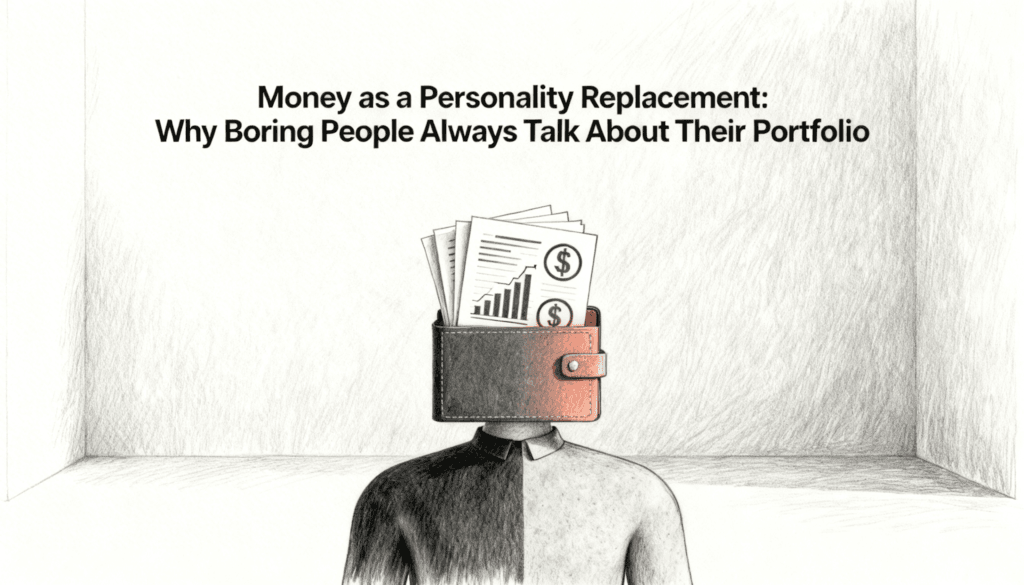
There is a particular kind of person who has a lot of money and very little of anything else. You have met them. They sit across from you at dinner and talk about their portfolio like it is a living thing that needs feeding. They have optimized their entire existence around a number on a screen. And if you ask them what they actually enjoy, they will pause longer than is comfortable.
This is not an article against money. Money is fine. Money is useful. Money buys you dentistry and plane tickets and the ability to leave situations you do not want to be in. What this article is about is the strange cultural habit of treating money as the destination rather than the vehicle.
Because here is the thing nobody tells you at business school: the richest people you will ever meet might not have the most money. And the poorest people you will ever meet might have quite a lot of it.
The Scoreboard Problem
Somewhere along the way, we collectively agreed that net worth was the primary measure of a life well lived. This is bizarre when you think about it for more than thirty seconds. We took one variable out of thousands and decided it was the final score.
Imagine doing this with anything else. Imagine judging a meal only by its calorie count. Imagine evaluating a friendship only by how many years it has lasted. The number tells you something, sure. But it does not tell you the thing that actually matters.
Money is measurable, and humans love what they can measure. We are deeply uncomfortable with things we cannot put a number on. How do you quantify the richness of knowing how to cook a meal that makes your friends go quiet with pleasure? How do you measure the wealth of being able to sit alone in a room and not reach for your phone? You cannot. And because you cannot, these things get treated as secondary. Nice to have. Optional upgrades.
But they are not optional. They are the entire point.
What “Rich” Actually Means When You Strip Away the Dollars
Think about the word rich for a moment. Rich soil. Rich color. Rich conversation. In every context except finance, rich means dense with substance, full of depth, layered and complex and rewarding. A rich chocolate cake is not a cake with money in it. It is a cake that delivers more than you expected.
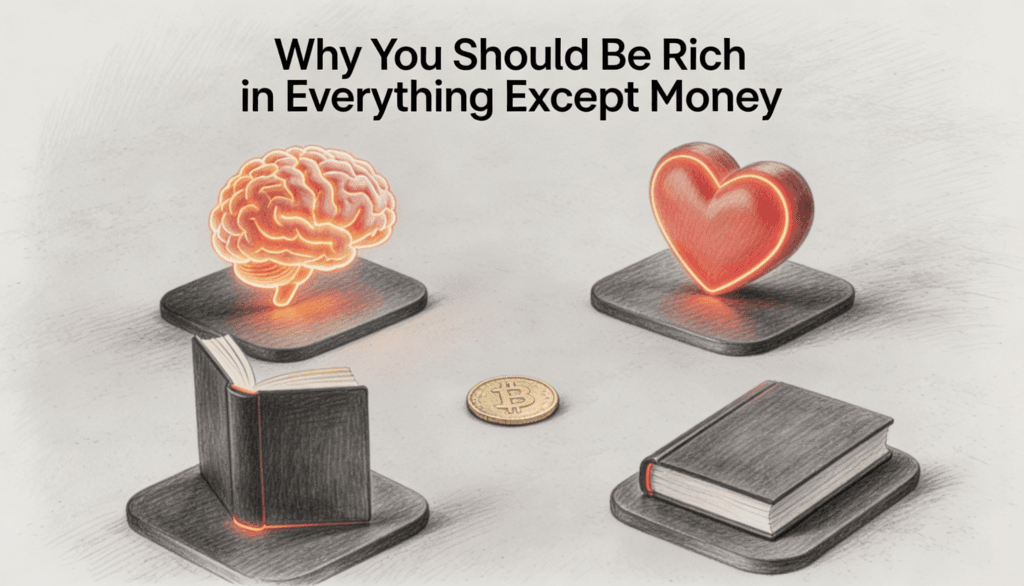
Being rich in everything except money means being dense with substance as a human being. It means having deep relationships, not just a wide network. It means having skills that are not on your resume. It means having experiences that did not cost much but changed how you see the world.
There is a man I know who earns a modest salary and speaks four languages, can fix nearly anything mechanical, and has friendships that have lasted decades. By every meaningful measure, this man is wealthy. He just does not show up on any rich list.
Then there are people who could buy a small island but have not read a book in years, cannot name their neighbors, and feel a low hum of anxiety every Sunday evening that no amount of money has managed to fix. They are, in every way that counts, operating at a deficit.
The Investor Paradox
Here is where it gets interesting for anyone who thinks about finance. The entire philosophy of investing is built on a concept that investors themselves often fail to apply to their own lives: diversification.
Any decent financial advisor will tell you not to put all your eggs in one basket. Spread your risk. Allocate across asset classes. Do not let a single position dominate your portfolio because if that one thing collapses, you lose everything.
Now apply that logic to life.
If your entire identity is built around your financial wealth, you are running a dangerously concentrated portfolio. You have gone all in on one asset class. And when that asset underperforms, and it will at some point, you have nothing to fall back on. No reserves of meaning. No hedges against existential crisis. No alternative sources of returns on the only investment that actually matters, which is your time on earth.
The people who weather financial downturns best are almost never the ones with the most money. They are the ones with the most everything else. The ones who have relationships that do not depend on their net worth. Skills that have value beyond the market. A sense of identity that is not pinned to a brokerage statement.
Diversify your life the way you diversify your portfolio. It is the same principle. The math of resilience does not change just because you move from spreadsheets to lived experience.
The Diminishing Returns Nobody Talks About
Economics has this elegant concept called diminishing marginal utility. The first slice of pizza is incredible. The second is good. The fifth is a mistake you will regret. Each additional unit delivers less satisfaction than the one before it.
Money follows this curve ruthlessly. The difference between earning nothing and earning enough to cover your basic needs is life changing. The difference between earning enough and earning twice enough is noticeable. The difference between earning ten times enough and twenty times enough is almost invisible in terms of actual daily happiness.
Studies have poked at this from various angles, and the findings are boringly consistent. Beyond a certain point of financial comfort, more money does not produce more wellbeing. It produces more stuff, more complexity, more things to manage and protect and worry about. But not more of the thing you were chasing when you started chasing money in the first place.
Meanwhile, the returns on being rich in other dimensions barely diminish at all. The hundredth deep conversation with someone you love is not less valuable than the first. Your tenth year of playing guitar still brings you joy. The fortieth book you read this year still has the power to rearrange your thinking. These are assets with a return curve that stays remarkably flat over time.
So from a pure returns perspective, over investing in money and under investing in everything else is just bad portfolio management.
The Status Trap and Its Escape Hatch
A huge portion of what drives wealth accumulation past the point of usefulness is status. And status is perhaps the most expensive thing you can buy because it never stays bought. There is always someone with more, someone newer, someone who just made you feel like your number is not big enough.
Status derived from money is a treadmill with a motor that speeds up every time you get comfortable. Status derived from competence, character, creativity, and contribution is a different machine entirely. It compounds quietly. It does not require constant feeding. And nobody can take it from you in a market crash.
Consider the reputation of a person who is known for being generous with their time, skilled at their craft, and genuinely interesting to talk to. That reputation is not volatile. It does not fluctuate with interest rates. It is, in investment terms, about as close to a risk free asset as a human being can build.
A Practical Framework for the Skeptics
If all of this sounds too philosophical, here is a more grounded way to think about it. Ask yourself what you would do if your net worth got cut in half tomorrow. Not what you would feel, because everyone would feel terrible. But what you would actually do. What would your days look like? Who would still be around? What would you still be good at? What would still bring you satisfaction?
If the answers to those questions are thin, that is useful information. It means your wealth is fragile because it is concentrated in a single dimension. It means you have been building a tower instead of a foundation.
Now ask the reverse. What if your net worth doubled but you lost your closest relationships, your health, your curiosity, and your ability to be present in a room without checking your phone? Would you take that trade?
Almost nobody says yes when the question is posed that directly. But plenty of people make that trade incrementally, one busy week at a time, one skipped dinner at a time, one “I will get to that later” at a time.
The Real Investment Thesis
Here is the contrarian bet, and it is not really that contrarian once you see it clearly. The highest returning investment most people can make is not financial. It is personal. It is learning something that has no immediate economic value. It is maintaining a friendship that requires effort. It is developing the ability to think clearly, to be alone without being lonely, to engage with the world as something more than a consumer or a producer.
These investments do not show up on any balance sheet. They do not compound in any way a spreadsheet can model. But they are the things that, at the end of everything, determine whether your life felt rich or just expensive.
Money is a means. Treat it like one. Be strategic about it, be smart about it, and then invest just as seriously in everything it cannot buy.
Because the goal was never to die with the most. The goal was to live with the most. And those are very different portfolios.