Table of Contents
The Day a Single Investor Almost Killed the United States Economy
The United States was barely three years old when one man with borrowed money came within weeks of collapsing the entire national financial experiment. His weapon was not a musket or an army. It was leverage, and the willingness to gamble other people’s money on a scheme so reckless that it reads like satire today.
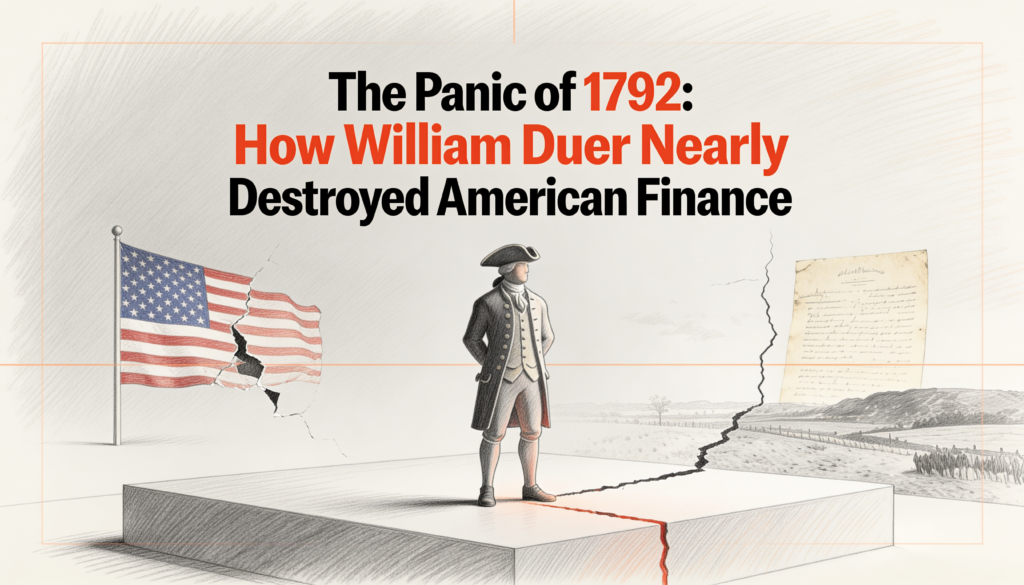
His name was William Duer, and the Panic of 1792 is the story of how he nearly destroyed American finance before it ever had a chance to prove itself. If you have never heard of him, that is precisely the kind of historical amnesia that allows the same financial mistakes to repeat across centuries. This was the first true financial crisis in American history, and almost everything that has happened on Wall Street since has followed the pattern Duer established.
The country had no track record, no credit history, and no financial infrastructure worth the name. It was, in every meaningful sense, a startup nation running on reputation and optimism. And then the most connected insider in that nation tried to corner an entire market.
The Most Connected Man in a Country That Barely Existed
Duer was born in England in 1743 to a wealthy planter family. He was educated at Eton, served briefly in the British military in India, and eventually migrated to New York in the early 1770s. He built a lumber business along the Hudson River, married into one of the most powerful families in the colonies, and George Washington personally gave the bride away at his wedding. He embedded himself in the political class of the emerging republic with remarkable speed.
By the time independence was won, Duer was a member of the Continental Congress and a signer of the Articles of Confederation. He was, on paper, a Founding Father. But his real talent was not patriotism. It was proximity to power combined with a complete inability to resist a quick profit.
This is important because it sets up one of the most underappreciated dynamics in financial history. Duer was not a rogue outsider. He was the ultimate insider. Alexander Hamilton, the first Secretary of the Treasury and the architect of the entire American financial system, personally appointed Duer as his Assistant Secretary of the Treasury.
The man responsible for helping Hamilton build the economic credibility of the United States was simultaneously scheming to exploit every crack in the system for personal gain. There is a lesson here that Wall Street still has not fully absorbed.
The most dangerous people in finance are not the ones standing outside the building trying to break in. They are the ones with offices on the top floor.
How Hamilton Built a Financial System and a Bubble at the Same Time
To understand what Duer did, you need to understand what Hamilton was trying to accomplish. And what Hamilton was trying to accomplish was nothing short of miraculous.
The new government had inherited roughly 75 million dollars in debt from the Revolutionary War, against approximately 4 million dollars in annual revenue. Hamilton’s plan was to consolidate this debt, assume the debts of the individual states, and create a national bank. The idea was that by honoring its debts, the new nation could establish creditworthiness. Investors in Europe, especially those nervously watching revolutionary France tear itself apart, might begin to see American government bonds as a safe bet.
It worked. Perhaps too well.
The Stock That Set the Country on Fire
When the Bank of the United States opened in late 1791, demand for its stock was enormous. Investors bought what were essentially promissory notes called scrips at 25 dollars each, agreeing to pay an additional 375 dollars in installments over the following two years. These installments had to be paid partly in cash and partly in United States government debt securities. So the demand for government bonds suddenly spiked as well.
Prices rose with terrifying speed. Scrips that started at 25 dollars were trading for 280 dollars in New York and reportedly over 300 dollars in Philadelphia within weeks. Hamilton watched from Philadelphia and did something that would not become standard central banking practice for another eighty years. He arranged for the Bank of New York to purchase government securities using Treasury funds to cool the market down.
It worked. Prices stabilized. But the genie was out of the bottle. People had seen how quickly money could be made in securities, and William Duer had been watching more closely than anyone.
The Scheme: A Masterclass in Everything You Should Never Do
After leaving the Treasury, Duer kept all his connections and insider knowledge. He also kept trading government securities for his personal account, which, even by the loose ethical standards of the 1790s, was deeply questionable.
In the winter of 1791, Duer partnered with Alexander Macomb, a New York businessman and land speculator, to execute one of the most audacious financial schemes in early American history. The plan was to corner the market in government bonds.
The logic was elegant in that reckless way speculative logic often is. If Duer and Macomb could buy up enough of these bonds, they would control the supply. Other investors would have no choice but to buy from them at inflated prices when their bank installments came due. With the profits, they planned to buy enough shares to take control of the Bank of the United States itself and even create a new bank to challenge the Bank of New York.
Building Credit Out of Thin Air
To fund all of this, they borrowed everything they could from every source they could find. They endorsed each other’s notes to create credit out of nothing. Duer even used funds from the Society for Establishing Useful Manufactures, a Hamilton backed industrial project, essentially lending himself other people’s money.
Word spread. Speculation fever gripped New York. People from every walk of life handed Duer money to invest on their behalf. There is a story, possibly embellished but wonderfully telling, that even a woman working at a New York brothel gave Duer money she had kept hidden under her mattress.
This is the part of any financial bubble that reads like comedy in hindsight and tragedy in real time. When the person managing your money is simultaneously borrowing from industrial societies, endorsing his own notes, and attempting to corner an entire market, the ending writes itself. But nobody ever reads the ending until after it has already happened.
The Collapse Came Faster Than the Country Could React
The Bank of the United States, having lent freely through December and January, began to tighten credit in February 1792. This was not a coordinated attack on Duer. It was simply a bank realizing that its reserves were draining at an alarming rate. Cash reserves dropped by over a third in a few months, and the bank stopped renewing about a quarter of its outstanding loans.
For Duer, this was fatal. His entire scheme depended on a continuous flow of borrowed money and a continuously rising market. When credit contracted, both collapsed at once.
On March 9, 1792, Duer stopped paying his creditors. That same day, the federal government filed suit against him. Whether this was coincidental timing or the Treasury sensing that Duer was going down and rushing to stake its claim first, nobody knows for certain. Either way, it was the financial equivalent of a building being hit by an earthquake and a wrecking ball on the same afternoon.
Contagion Spreads Through the New Nation
The panic spread immediately. Securities’ prices dropped over 20 percent in two weeks. Commerce in New York essentially froze. Merchants upriver refused to unload wheat from their ships because nobody could pay in hard currency. Land prices in Pennsylvania fell by two thirds. The contagion reached Philadelphia.
On March 23, just two weeks after he stopped payments, Duer walked into debtors prison. Not because he was dragged there, but because angry mobs were gathering outside his Broadway mansion and prison was genuinely the safer option.
Consider that for a moment. The man who had been dining with presidents was now seeking protection from the very people whose savings he had vaporized. He never came out. William Duer died in that prison seven years later, in 1799.
Hamilton’s Response Became the First Bailout in American History
Here is where the story becomes genuinely instructive from a systems perspective. Hamilton had every reason to let Duer fail and disappear from the narrative. Duer had embarrassed him, abused the trust of their friendship, and exploited the very financial architecture Hamilton was trying to build. A lesser politician would have stepped back and let the wreckage speak for itself.
Instead, Hamilton invented central banking crisis management on the fly, with no playbook to follow.
- He directed the Bank of New York to make open market purchases of government securities to stabilize prices.
- He convened the Sinking Fund Commission, a group including John Adams, Thomas Jefferson, and the Chief Justice, to authorize emergency government purchases.
- When the commission deadlocked with one member absent, he maneuvered politically until he secured the votes.
- He encouraged banks to lend freely against good collateral during the panic.
By May, the panic had subsided. No recession followed. The American financial system survived its first stress test.
What Hamilton did was counterintuitive and worth studying closely. He saved a system that his own friend had tried to destroy, using tools he was inventing in real time, while his political opponents, with Jefferson prominent among them, used the crisis as evidence that Hamilton’s entire financial project was corrupt.
He chose the system over the person, and in doing so he set a precedent that every future Treasury Secretary and central banker would eventually follow, whether they knew it or not.
What Actually Survived: The Birth of the Stock Exchange
The Panic of 1792 produced an unexpected offspring. In the chaos of the crash, the securities dealers of New York realized they needed rules. They needed a framework for trading. They needed trust.
On May 17, 1792, twenty four brokers gathered under a buttonwood tree on Wall Street and signed what became known as the Buttonwood Agreement. They agreed to trade only with each other, to charge fixed commissions, and to operate with a set of shared standards. This informal agreement became the foundation of what eventually grew into the New York Stock Exchange.
So the first financial crisis in American history directly created the institution that would host most of the major financial crises that came after it. History does not lack a sense of humor.
The Lesson That History Keeps Refusing to Learn
The Panic of 1792 is often treated as a footnote, a minor episode in the founding era, overshadowed by constitutional debates and foreign policy struggles. But it established a pattern that has repeated with mechanical reliability for over two centuries.
The Pattern Behind Every Financial Crisis
The pattern goes like this. A new financial innovation creates genuine value. Credit expands to fund participation in that innovation. Speculators use the expanding credit to take positions far larger than their actual capital. The leverage creates fragility. Some trigger, often minor, sets off a cascade. The system freezes. A government institution steps in to restore confidence. And then, almost immediately, everyone begins the process of forgetting.
Duer was not a financial genius. He was not even particularly creative. What he was, more than anything, was greedy in a way that felt entirely rational at the time. Every speculator who has blown up since, from the railroad barons of the 1800s to the mortgage traders of 2008, has followed roughly the same script. The only thing that changes is the asset class.
Why the Timing Made It So Dangerous
What makes the Panic of 1792 uniquely instructive is its timing. This happened when the country was barely functional. The institutions that saved the system were weeks old. The man who solved the crisis was improvising every step of the way.
If Duer had succeeded in cornering the bond market and destabilizing the Bank of the United States before Hamilton could respond, the entire American financial experiment might have collapsed in its infancy. Foreign investors would have pulled back. The government’s ability to borrow would have evaporated. The political opponents of federal power would have had all the ammunition they needed to dismantle the Hamiltonian system.
One man with borrowed money and no ethics almost undid the whole thing. And the only reason he did not is that another man, armed with nothing but intelligence and political skill, decided the system mattered more than the scandal.
That is not merely financial history. That is the kind of story that reveals everything about how fragile the things we take for granted truly are. The next time a market climbs on borrowed money and easy confidence, remember the man who nearly burned down a nation before it had finished being built.