Table of Contents
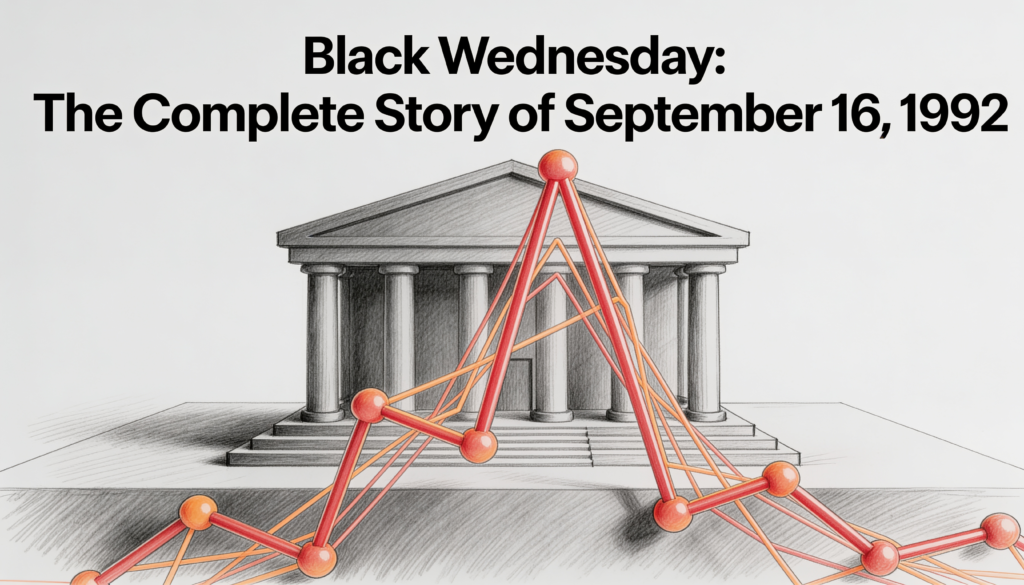
On September 16, 1992, the British government spent an estimated £3.3 billion in a single day trying to prop up the pound sterling. By 7:30 that evening, it was over. Britain crashed out of the European Exchange Rate Mechanism, the pound plunged, and Chancellor of the Exchequer Norman Lamont stood before the cameras outside the Treasury to announce the defeat. Behind the scenes, a Hungarian born hedge fund manager named George Soros had placed a $10 billion bet against the pound and won roughly $1 billion in profit in a matter of hours. This is the complete story of Black Wednesday, the day a central bank discovered it could not outspend the market.
Britain Joins the European Exchange Rate Mechanism
The European Exchange Rate Mechanism, known as the ERM, was created in 1979 to reduce currency volatility across Europe. Member nations agreed to peg their currencies to one another within narrow fluctuation bands, typically 2.25 percent above or below an agreed central rate. The anchor currency was the German Deutsche Mark, backed by the powerful and inflation averse Bundesbank. The long term goal was straightforward: stabilize exchange rates as a stepping stone toward a single European currency.
Britain initially stayed out. Margaret Thatcher was skeptical of tying the pound to a mechanism that would limit Britain’s monetary independence. But by 1990, pressure from within her own cabinet had become intense. Chancellor John Major and Foreign Secretary Geoffrey Howe both argued that ERM membership was essential for Britain’s credibility in Europe and would help bring down inflation, which was running above 10 percent.
On October 8, 1990, Britain joined the ERM. The pound was pegged to the Deutsche Mark at a central rate of 2.95 DM to the pound, with a permitted fluctuation band of 6 percent. Many economists at the time, including several within the Treasury itself, believed this rate was too high. The pound was arguably overvalued by 10 to 15 percent relative to Britain’s underlying economic fundamentals. But the rate was chosen for political reasons as much as economic ones. A strong pound signaled strength and seriousness at the European negotiating table.
The timing could not have been worse. Britain was sliding into recession. Unemployment was rising. The housing market was collapsing. The economy desperately needed lower interest rates to stimulate growth and ease the burden on mortgage holders across the country.
The German Reunification Problem
Across the English Channel, Germany was dealing with the opposite problem. The reunification of East and West Germany in October 1990 had triggered an enormous fiscal expansion. The German government was spending heavily to rebuild the East, and the Bundesbank was worried about inflation. Its response was to raise interest rates aggressively. By mid 1992, the Bundesbank’s key lending rate had reached 8.75 percent.
This created an impossible contradiction at the heart of the ERM. To maintain the peg, Britain had to keep its interest rates at or above German levels. But Britain’s recession demanded rate cuts. The country was locked into a monetary straitjacket designed for a healthy German economy, not a struggling British one. Base rates in Britain sat at 10 percent while the economy contracted, crushing businesses and homeowners alike.
By the summer of 1992, currency traders and economists around the world were openly questioning whether Britain could sustain the peg. The pound repeatedly drifted toward the bottom of its permitted band. The Bank of England intervened regularly, buying pounds with its foreign currency reserves to prop up the rate. Each intervention was expensive, and each one only delayed the question: how long could this last?
George Soros and the Quantum Fund Build Their Position
George Soros ran the Quantum Fund from offices in New York. His head of trading was Stanley Druckenmiller, a disciplined and analytically gifted fund manager who had been studying the ERM’s structural weaknesses for months. Druckenmiller identified the core problem clearly: Britain could not simultaneously maintain the ERM peg and pursue the monetary policy its economy required. One of those two things would have to give.
In August 1992, Druckenmiller began building a short position against the pound. He initially proposed a position of roughly $1.5 billion. When he brought the analysis to Soros, the older investor studied the numbers and asked a question that would become legendary in trading circles. Soros wanted to know why the position was so small. If the analysis was correct and the risk reward was as favorable as Druckenmiller described, Soros argued they should go bigger. Much bigger.
By early September, the Quantum Fund had built a short position of approximately $10 billion against the pound sterling. This was a staggering figure, larger than the fund itself, made possible through leverage and the use of currency forwards and options. Soros and Druckenmiller were not the only ones betting against the pound. Other major hedge funds, banks, and institutional traders were reaching similar conclusions. But the Quantum Fund’s position was the largest single bet.
Bundesbank President Schlesinger’s Fateful Remarks
On September 15, the day before Black Wednesday, Bundesbank President Helmut Schlesinger gave an interview to the German financial press. His remarks, published that evening and widely circulated overnight, included a statement that one or two currencies in the ERM might come under pressure and would need to be devalued. He did not name the pound explicitly, but the implication was unmistakable.
Schlesinger’s comments were the spark. When Asian and then European markets opened on September 16, the selling of the pound was immediate and overwhelming. Traders interpreted the Bundesbank president’s words as a signal that Germany would not cut its own interest rates to help Britain maintain the peg. Britain was on its own.
The Hour by Hour Crisis of September 16, 1992
The day began before dawn. The Bank of England started buying pounds heavily as soon as European currency markets opened, spending hundreds of millions of pounds in foreign currency reserves during the early morning hours. The pound kept falling, pressing against the bottom of its permitted ERM band.
7:00 AM: Bank of England traders were already intervening aggressively. Despite massive purchases, the pound refused to rise above its ERM floor.
11:00 AM: Chancellor Norman Lamont and Prime Minister John Major authorized an emergency interest rate increase. The base rate went from 10 percent to 12 percent in a single jump, an extraordinary move meant to signal absolute commitment to the peg. The hope was that higher rates would attract foreign capital into pounds and reverse the selling pressure.
The market’s reaction was devastating. Instead of recovering, the pound barely moved. Traders interpreted the rate hike not as a sign of strength but as a sign of desperation. Selling intensified.
2:15 PM: With the first rate hike having failed, the government announced a second increase. Interest rates would go to 15 percent, effective the following day. Britain now had interest rates that would have been crippling for an economy already deep in recession. Mortgage rates, business loans, and consumer credit would all be affected.
The second hike also failed. The pound continued to sink. The Bank of England was burning through reserves at a rate that could not be sustained. Estimates suggest the Bank spent up to £27 billion buying pounds over the course of the crisis, with a net loss to taxpayers ultimately calculated at £3.3 billion by the Treasury.
5:00 PM: Emergency meetings took place across Whitehall. The options had narrowed to two: continue defending the peg at a cost that was becoming politically and economically unthinkable, or withdraw from the ERM entirely.
7:30 PM: Norman Lamont appeared outside the Treasury building to make the announcement. Britain was suspending its membership in the European Exchange Rate Mechanism. The second interest rate rise to 15 percent was cancelled. The base rate was returned to 12 percent and would be cut to 10 percent the following day, with further cuts to follow.
Lamont later described the experience with a memorable line. Speaking to reporters, he said the day had been extremely difficult and that he had been “singing in the bath“ that evening, a remark widely reported and often misinterpreted. He later clarified he was expressing relief that the crisis was over, not celebrating the outcome.
The Aftermath and Economic Recovery
The pound fell approximately 15 percent against the Deutsche Mark in the weeks following Black Wednesday. It also dropped roughly 25 percent against the US dollar over the subsequent months. For a country that had spent billions defending the currency, the collapse was humiliating.
But something unexpected happened next. The British economy began to recover. Freed from the obligation to maintain artificially high interest rates, the Bank of England was able to cut rates to levels appropriate for a country in recession. Lower rates eased the burden on mortgage holders and businesses. The weaker pound made British exports more competitive internationally.
GDP growth turned positive. Unemployment began to fall. Inflation remained under control. Britain entered a period of sustained economic expansion that would last through the rest of the 1990s. Many economists now regard Black Wednesday as the moment that inadvertently set the stage for one of Britain’s longest postwar growth periods.
The Political Fallout
The political consequences were severe and long lasting. The Conservative Party’s reputation for economic competence, which had been its strongest electoral asset for decades, was destroyed in a single afternoon. The Conservatives under John Major won the 1992 general election in April, just five months before Black Wednesday. They would not win another general election for 13 years.
Norman Lamont was removed as Chancellor in May 1993. John Major survived as Prime Minister until 1997, but his government never recovered its authority. The Labour Party under Tony Blair won a landslide victory in the 1997 general election, and the memory of Black Wednesday was a significant factor in that outcome.
George Soros earned an estimated $1 billion in profit from the trade. He became known globally as “the man who broke the Bank of England,” a title that obscured the fact that dozens of other institutions were making the same bet. Soros was the largest single participant, but the selling pressure on Black Wednesday was a collective market verdict, not one man’s attack.
Why Black Wednesday Still Matters for Investors
The 1992 pound crisis was not a one time event. The same fundamental dynamic has repeated in different forms around the world. During the 1997 Asian financial crisis, Thailand, South Korea, and Indonesia all maintained fixed or managed exchange rates that diverged from economic reality. All three were eventually forced into painful devaluations. In January 2015, the Swiss National Bank abruptly abandoned its peg of the Swiss franc to the euro, causing the franc to surge 30 percent in minutes and wiping out several currency trading firms entirely.
The pattern is consistent. A government or central bank fixes a price. Economic conditions change so that the fixed price no longer reflects reality. The authority spends increasingly large sums defending the price. Eventually, the cost of defense exceeds the capacity or willingness to pay, and the price moves violently to its market level.
For anyone managing money or studying financial history, Black Wednesday offers three concrete observations worth remembering:
- Central banks have enormous power but finite resources. The Bank of England in 1992 had billions in reserves. It was not enough. No reserve pool is infinite, and when markets collectively move against a fixed price, the mathematics of supply and demand will eventually overwhelm any single institution.
- The cost of maintaining an artificial price is cumulative and accelerating. Britain spent modestly on intervention in the months before Black Wednesday. On the day itself, it spent billions. The closer a fixed price gets to its breaking point, the more expensive each hour of defense becomes.
- The correction, when it comes, often produces better outcomes than the defense. Britain’s post Black Wednesday recovery was stronger than anything the ERM peg was delivering. The economic pain the government was trying to prevent by maintaining the peg was less than the pain the peg itself was causing.
Black Wednesday cost £3.3 billion. It ended political careers. It made George Soros one of the most famous investors in history. It reshaped the trajectory of European monetary integration. And it remains, more than three decades later, the clearest single day demonstration that no institution, regardless of its power or prestige, can indefinitely maintain a price that the underlying economics do not support.